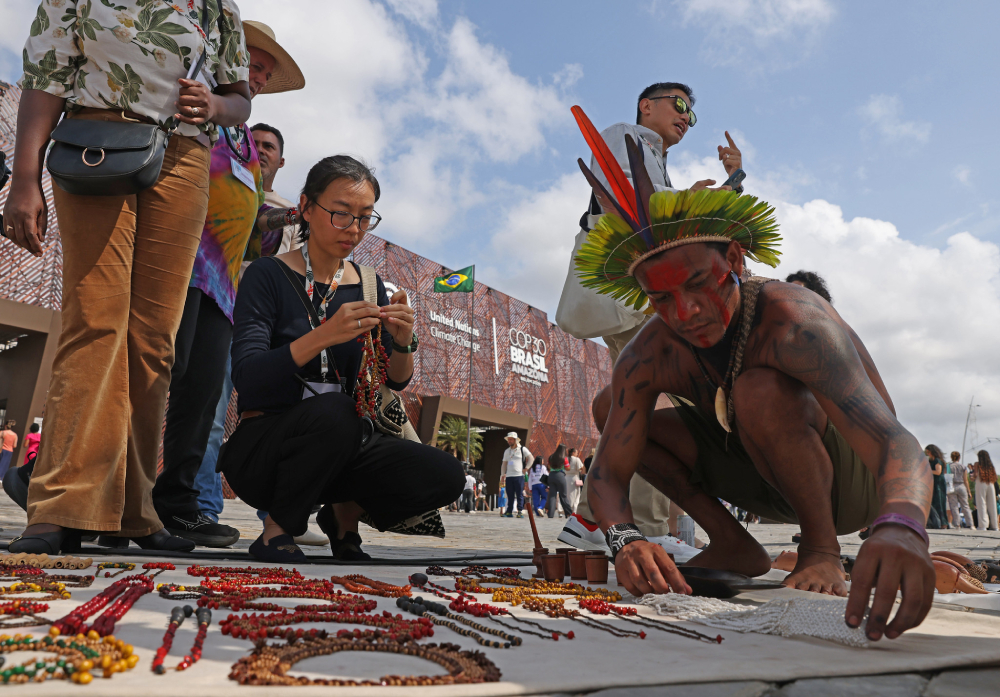
Indigenous people sell products at the entrance to the blue zone at the COP30 United Nations climate change conference in Belém, Brazil on Nov. 12. (COP30/Sergio Moraes)

by Eduardo Campos Lima
The recently concluded United Nations climate summit held at the edge of the Brazilian Amazon drew heightened attention to the vast rainforest's critical role in regulating global temperatures, and with it unprecedented participation at high-stakes meetings from Indigenous groups and local populations.
From the official "blue zone" venue to the streets and streamways of Belém, Indigenous voices, and Brazilian groups in particular, echoed throughout COP30 in calling for land rights over their ancestral territories and for such protections to be recognized as a key climate solution.
While Indigenous communities for centuries have played leading roles in conserving the world's forests, which stand as a critical element in reducing heat-trapping carbon emissions, it's unclear to what degree the negotiations took them into account.
"The Brazilian Indigenous groups were well organized to attend COP30, thanks to the work of their own associations," said Cardinal Leonardo Steiner, the archbishop of Manaus, Brazil and the first cardinal from the Amazon region. Assisting them were groups like the Brazilian bishops conference's Indigenous Missionary Council (CIMI), which Steiner leads as president.
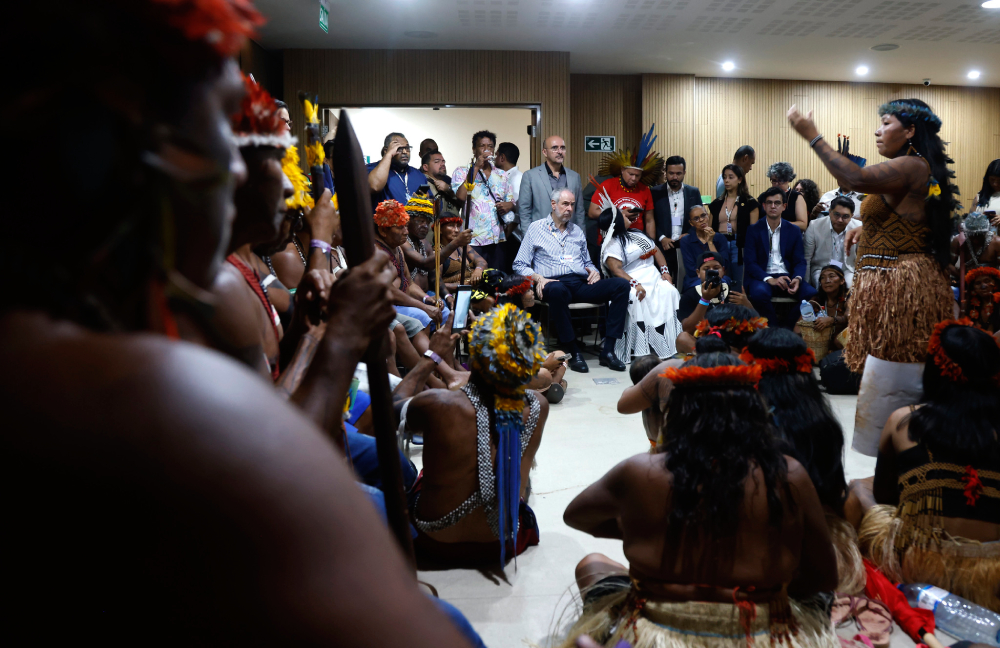
The president of COP30, André Correa do Lago, Sonia Guajajara, Minister of Indigenous Peoples of Brazil and Marina Silva, Minister of State for the Environment and Climate Change of Brazil, attend a meeting with Indigenous peoples at the COP30 United Nations climate change conference in Belém, Brazil on Nov. 4.(COP30/Hermes Caruzo)
The cardinal said Indigenous activists throughout the two weeks of COP30 made their views clear while denouncing the invasion and deforestation of their lands, and the government's failure to deal with those situations in Brazil.
"Of course, we don't know if they have been heard by the international delegations. But they did their part, and that's very important for their self-organization and for their future," he said.
More than 5,000 Indigenous people attended COP30, with 4,000 of them from Brazil alone. Of them, 900 were accredited as delegates. Together, it represented the largest-ever Indigenous contingent in the 30-year history of U.N. climate summits.
Many arrived in Belém on the roughly 200-boat flotilla that kicked off the People's Summit, a five-day parallel gathering of civil society organizations where Indigenous nations led numerous talks about the challenges they face in their lands.
Indigenous activists were numerous among the estimated 70,000 demonstrators at the Global Climate March on Nov. 15. They staged an Indigenous march two days later, drawing at least 3,000 participants. Protests at two points occupied the blue zone and blocked entrance into the venue.
"Our struggle for territorial rights occurs all over the country. Unfortunately, most leaders have been continuously arrested and killed," said Alberto França Dias, a Terena leader and a coordinator of the Articulation of Indigenous Peoples of Brazil (APIB), one of the leading groups in organizing Indigenous participation at COP30.
Protections for Indigenous lands
A top priority for many Indigenous communities was protection of ancestral territories, not only for securing their livelihoods but as a climate policy itself.
Indigenous peoples play a leading role in conservation as their homelands intersect with large swaths of the planet's biodiversity, including forests — a key player in mitigating climate change. Trees pull carbon dioxide, the primary greenhouse gas driving global warming, from the atmosphere and store it in the ground.
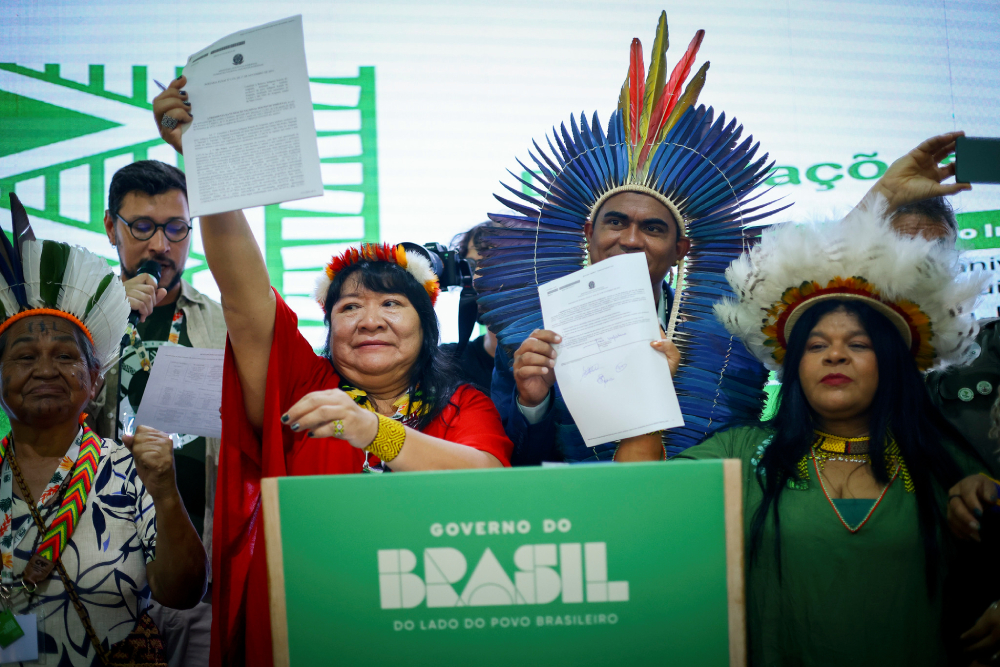
Joenia Wapichana, president of Brazil's National Indigenous Peoples' Foundation and Sonia Guajajara, Minister for Indigenous Peoples of Brazil attend a signing ceremony for the delimitation of lands with National Foundation of Indigenous Peoples and the celebration of the declaration and homologation decrees for indigenous lands, at the COP30 United Nations climate change conference in Belém, Brazil on Nov. 18. (COP30/Ueslei Marcelino)
In the final documents adopted at COP30, nearly 200 countries recognized "the vital role of indigenous peoples and local communities and the need to support them in the sustainable management and use of forests, as well as the importance of recognizing their land rights and traditional knowledge, including as a part of long-term mitigation policies."
That inclusion was celebrated by APIB. The group also saw progress in countries acknowledging the need for both Indigenous participation in climate adaptation measures and a just transition to clean energy — especially relevant in mining of rare-earth minerals — along with free, prior and informed consent in climate solutions involving their territories.
"There can be no climate action without the inclusion of Indigenous peoples and territories at the center of climate debate and agreements," APIB said in a statement.
Still, they criticized countries' failure to adopt roadmaps on ending fossil fuels and deforestation, as well as "insufficient" funding for adaptation measures and a lack of safeguards to ensure protections for their territories. They also repeated calls for Indigenous peoples to be included in official climate negotiations.
Outside the COP30 agreements, Indigenous groups in Brazil secured progress in their central goal of protecting their territories when President Luiz Inácio Lula da Silva's administration signed 10 "demarcation" ordinances officially recognizing land rights and territorial boundaries for seven Indigenous nations. It also advanced demarcation processes with 17 other Indigenous lands, and another 11 territories were established as Indigenous reserves.
Leaders with APIB and other observers believe Indigenous-led demonstrations in Belém put pressure on Lula's administration.
"Maybe the government waited for COP30 to announce such land grants in order to emphasize the importance of Indigenous groups in the process of combating climate change," Steiner told EarthBeat.
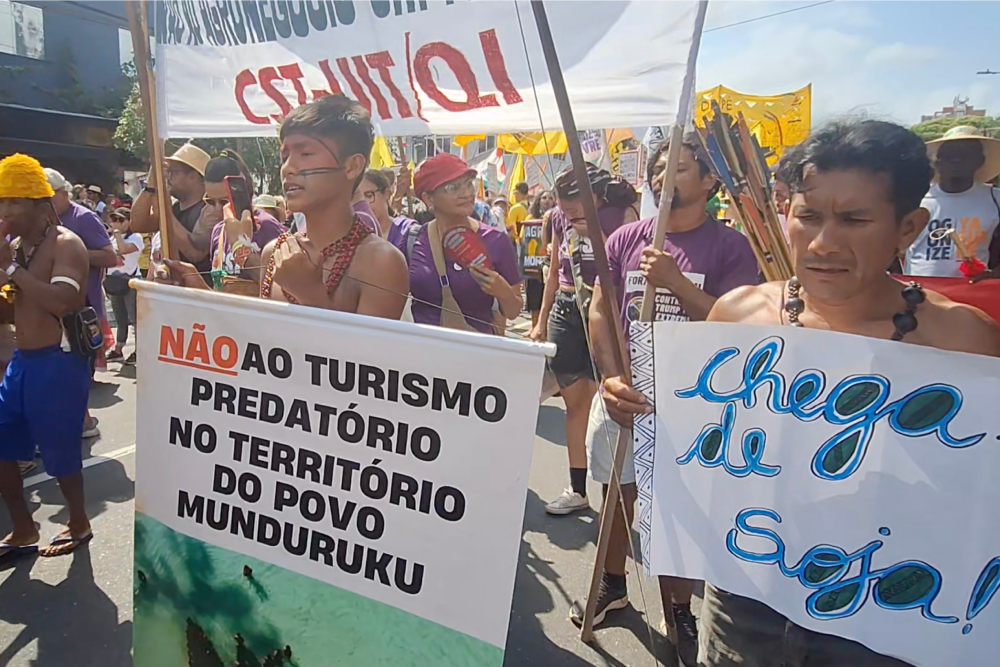
Indigenous groups from different parts of Brazil took part in the global climate march at the COP30 United Nations climate change conference in Belém, Brazil on Nov. 15. (Eduardo Campos Lima)
Ivanilda Torres dos Santos, adjunct secretary of the Brazilian bishops' Indigenous Missionary Council, said the announcements around the 27 Indigenous lands "still fall far short of the vast number of Indigenous lands whose demarcation processes have not yet even been initiated."
Other deals announced at COP30 included the Intergovernmental Land Tenure Commitment, where 15 countries pledged to recognize and secure 160 million hectares (395 million acres) of Indigenous and local community territories by 2030; a pledge of $1.8 billion to support securing territorial rights globally for Indigenous, local populations and Afro-descendent communities; and a guarantee that 20% of funds to the Tropical Forest Forever Facility go directly to Indigenous and local community organizations.
The tropical forest fund drew criticism from 150 Indigenous and civil society organizations, which said it relies too heavily on market solutions, fails to address the structural causes of deforestation and does not prioritize Indigenous peoples and local communities.
Torres dos Santos said the fund "virtually commodifies Indigenous territories."
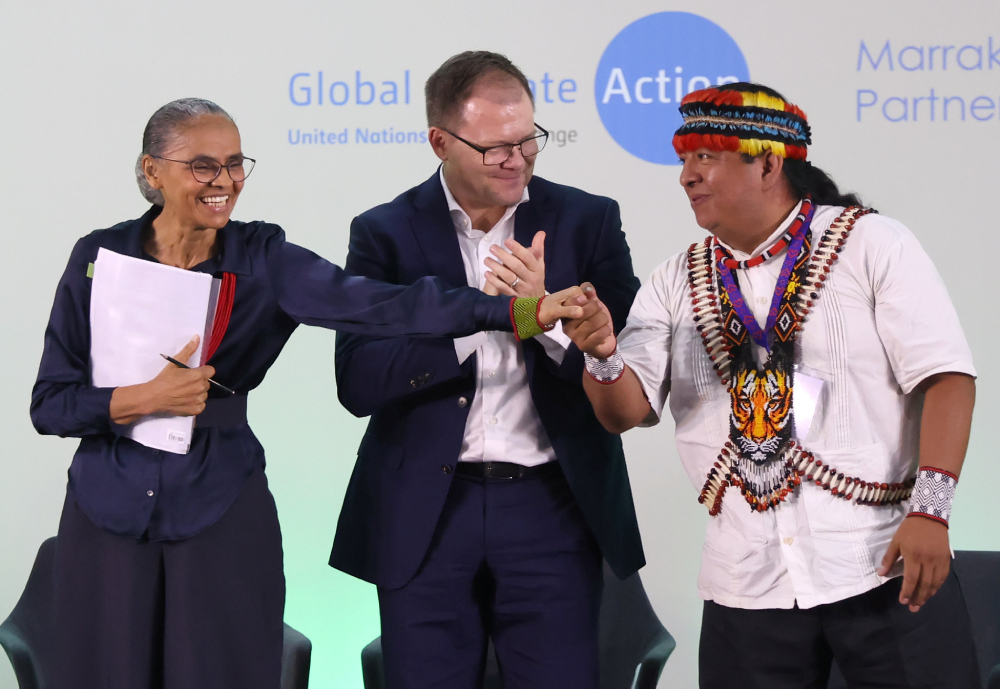
Marina Silva, Minister of State for the Environment and Climate Change of Brazil, Carsten Schneider, Minister of the Environment of Germany and Activist Juan Carlos Jintiach, attend the “Bioeconomy Challenge: catalysing systemic action through the Bioeconomy High Level Principles” during the COP30 United Nations climate change conference in Belém, Brazil on Nov. 7. (COP30/Aline Massuca)
"This is a false solution," she told EarthBeat. "The countries will pay in order to continue polluting, and the resources, as is well known, will not reach those on the front lines — the protectors of nature and the victims of climate change."
The struggle to secure Indigenous lands in Brazil continues, Dias said. He noted that his Terena people are still in the process of securing control of their territory, and that during COP30 a Guarani Kaiowá activist was killed in Mato Grosso do Sul while occupying a farm on ancestral lands.
"When the 1988 Constitution was promulgated, a deadline of five years was established for the Brazilian State to grant all Indigenous lands to their legitimate occupiers. After almost four decades, the process is far from being concluded," Dias said.
Climate stories around the globe
While official recognition of their rights to occupy traditional territories is a fundamental step, it's not enough to ensure that their lands won't be invaded and devastated, said Indigenous leaders from across the globe at COP30.
In Colombia, the Emberá people have fought with different waves of invaders for decades.
"We play our role in order to protect our lands. We had to expel numerous destroyers of the environment over the years, like drug dealers, illegal loggers and now illegal miners," Emberá leader Alberto Achito told an audience during a talk about native peoples co-hosted by Caritas Australia.
Achito said his nation's territory has faced large invasions of gold miners, which impacts their food and local water streams.
Advertisement
At a Nov. 18 press conference, Takesa Frank, an Aboriginal woman from Australia, described how her Yuin people struggled to protect their land amid the massive 2019-2020 bushfires exacerbated by climate change. An estimated 85% of the local forest was destroyed and over 3 billion animals were either killed or displaced.
"Only three months after that, we saw the same trees — which we fought so hard to protect — being chopped down by loggers," she said. The shock prompted her to become a climate activist.
In Fiji, villagers witness the seas rising and heating, which has led to bleaching of the rich coral reefs surrounding islands and more unpredictable rains, storms and droughts.
"All those aspects heavily impacted the production of food and work in the villages," Lavenia Naivalu, a community leader from the district of Nacula, told EarthBeat. Many people, especially men, are moving to Australia or New Zealand to find work on farms, she said, putting further strain on families left behind.
Similarly, the monsoon system in Bangladesh has been disrupted, with storms releasing in days the water volume that normally fell over a few months, said Zakir Shahin, who heads a community organization named Farmers' Voice.
"There's no rain pattern anymore, so we can't predict when to plant," he said, adding the massive storms have led to severe flooding of cropfields and entire villages.
A veteran of seven U.N. climate summits, Shahin said he didn't expect much from COP30.
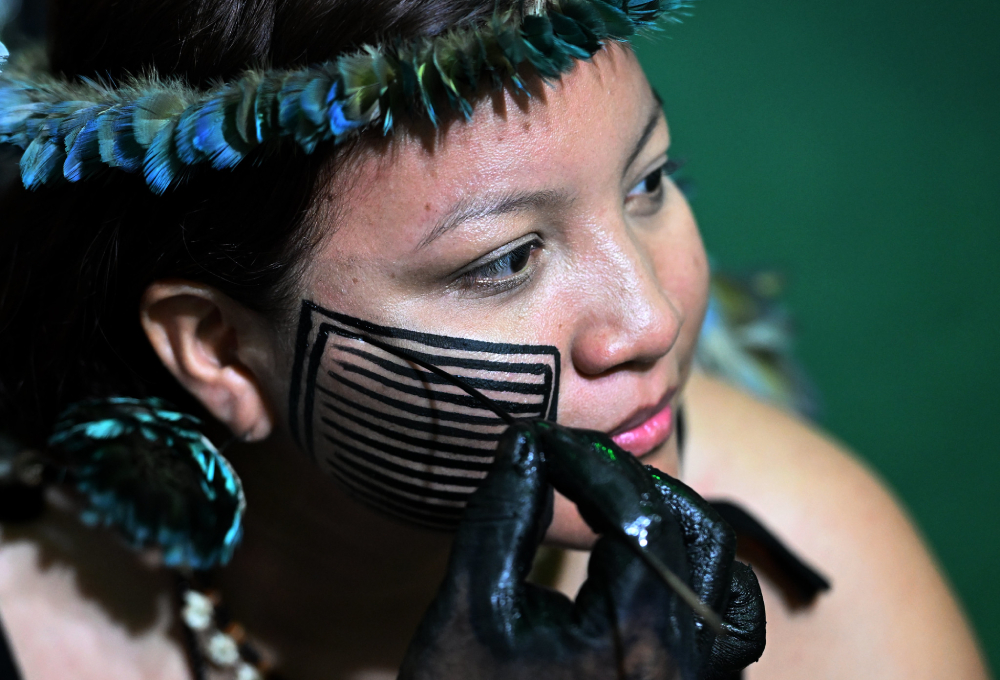
A person's face is inked as visitors stroll through the Green Zone corridor at the COP30 United Nations climate change conference in Belém, Brazil on Nov. 18. (COP30/Alex Ferro)
"There are positive commitments, but later they end up not being implemented," he said. He specifically cited financing, including compensation for Indigenous and other communities affected by climate-related disasters.
"Money doesn't reach the climate victims," he said.
Thousands of Indigenous leaders and activists shared testimonies of how climate change, along with its causes and proposed solutions, have caused suffering in their communities. While those stories were told, Torres dos Santos is unsure how much they were heard by delegates in the negotiating rooms.
"Their participation in this sense was visible, but when it came to the actual decisions, there was no such involvement," she said.