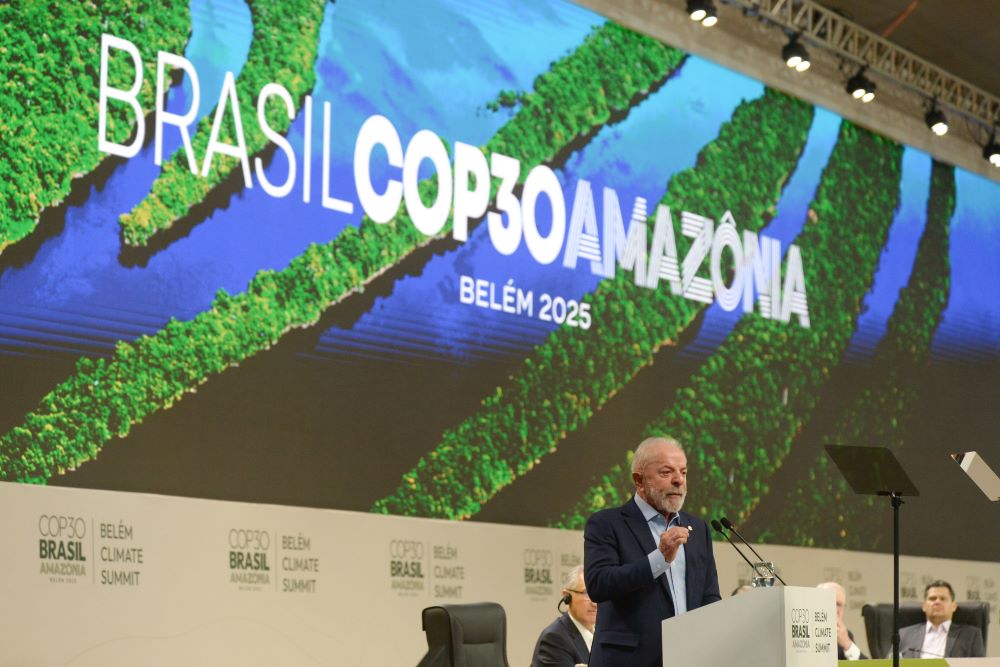
Brazil's President Luiz Inacio Lula da Silva attends the opening of the General Plenary of Leaders on Nov. 6 during the United Nations climate change conference COP30 in Belém, Brazil. Lula called for countries to deliver roadmaps to transition away from fossil fuels, and to halt and reverse deforestation. (COP30/Antonio Scorza)

by Eduardo Campos Lima
For the first time, the United Nations climate change negotiations are taking place at the edge of a tropical rainforest, a setting many are still waiting to see if it can inspire governments to take strong actions not only to limit rising temperatures on the planet but preserve its life-sustaining forests.
Belém, the capital city of the northern Pará state that is hosting COP30, is considered a gateway to the Amazon — the expansive, biome that is one of the "lungs of the earth" that serves as a significant "carbon sink" by absorbing and storing heat-trapping emissions driving global warming.
While environmental activists and Catholic officials here acknowledge the U.N. climate talks, taking place Nov. 10-21, have placed an unprecedented focus on forests, they fear it may fail to establish concrete commitments when it comes to protecting rainforests like the Amazon.
Church activists and officials who work in the Amazon know acutely the difficulties in preserving the rainforest, especially due to economic constraints. They think positive measures can be announced at the end of the conference, though no miracles are expected.
'We know that public policies often don't reach the most distant and vulnerable places. The logic that keeps resources concentrated among few people impedes more changes.'
—Archbishop Roque Paloschi
"COP30 is a signal of hope, but we cannot fool ourselves. The Amazon, like Pope Francis said in Puerto Maldonado [in 2018], is facing its most serious threat," Archbishop Roque Paloschi of Porto Velho, in the upper Amazon River basin, told the National Catholic Reporter's EarthBeat.
Paloschi, who couldn't attend the event but has been following it from a distance, said alternatives may emerge from the negotiations during COP, but they will probably have limits.
"We know that public policies often don't reach the most distant and vulnerable places," he said. "The logic that keeps resources concentrated among few people impedes more changes."
Since its start, COP30 has garnered a reputation as the "Forest COP."
During the leaders summit Nov. 6, Brazil's President Luiz Inácio Lula da Silva announced creation of the Tropical Forest Forever Facility, a public-private fund to compensate developing countries for forest conservation. So far, 53 countries have endorsed the fund and $5.5 billion has been pledged.
Marina Silva, Brazil's environment and climate minister, called the fund "a turning point in the history of tropical forest conservation."
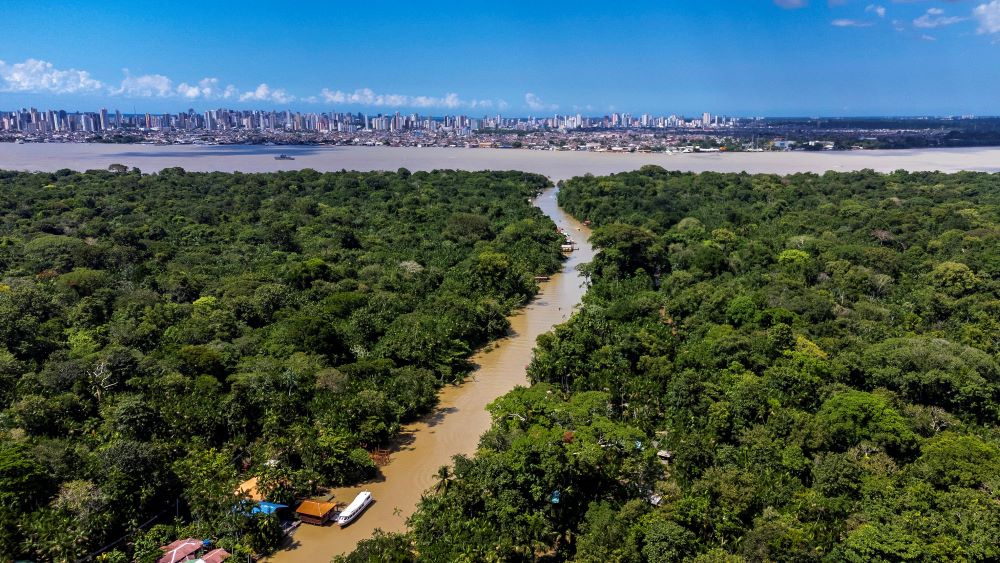
A drone view from Combu Island shows the city of Belém, Brazil, in the background. Belém is considered a gateway to the Amazon, known as one of the "lungs of the earth." (COP30/Alex Ferro)
In his speech at the world leaders summit, Lula called for countries to deliver in Belém two roadmaps, one to transition away from fossil fuels and the other to halt and reverse deforestation. So far, about 40 countries have backed the forest roadmap plan, while more than 80 have lent support to the fossil fuel roadmap.
At COP26 in Glasgow, Scotland, in 2021, more than 140 countries — representing roughly 85% of the world's forests — signed onto a pledge to end deforestation by 2030. A progress report published in October found that 8.1 million hectares (31,000 square miles) of forest were lost in 2024, well off the trajectory to meet the 2030 target.
About half of forest loss last year resulted from wildfires, with the Amazon Basin especially impacted. Brazil alone accounted for 42% of the global tropical forest loss, with two-thirds resulting from fires exacerbated by drought.
Rainforests play a critical role in mitigating climate change. The vast networks of trees pull carbon dioxide, the primary greenhouse gas driving climate change, from the atmosphere and store it in the ground. When forests are destroyed, whether by fires or through human activities like mining and agriculture, they release stored carbon emissions.
"Only keeping the rainforests up will not avoid global warming, but without them it's impossible to fight it," Rodrigo Agostinho, head of the Brazilian Institute of Environment and Renewable Natural Resources, told EarthBeat.
In their unprecedented joint appeal, which cardinals and other Catholics have continually highlighted at COP30, the continental bishops' conferences for Latin America, Africa and Asia deplored "the devastation of the tropical forests of the Global South — the Amazon, the Congo Basin, Borneo and the Mekong Basin — which are being transformed into pastures, biofuel plantations and monoculture." The bishops of the Global South demanded countries meet the 2030 target to end deforestation but without methods that "financialize nature," like carbon markets where credits for emissions allowances can be traded among countries.

Rodrigo Agostinho, head of the Brazilian Institute of Environment and Renewable Natural Resources, speaks with reporters at COP30 in Belém, Brazil. (Eduardo Campos Lima)
"The carbon credit market is a deception," said Paloschi, who like many Catholic officials and activists working in the Amazon, distrusts mechanisms involving finance and market solutions. "The people who really preserve the forest must be valued and incentivized, but not the middleman, the speculator who buys and sells."
Conservationists have said that for COP30 to live up to its promise of action and implementation, more conclusive decisions are needed around protecting rainforests.
During a Nov. 18 press conference, leaders with major environmental organizations endorsed the proposal of a deforestation roadmap, saying forests are a central component to achieving the Paris Agreement's goals, namely limiting global warming to 1.5 degrees Celsius (2.7 degrees Fahrenheit). Along with restoring forests, they said, such a roadmap is necessary to address land rights of Indigenous groups and local communities, and to provide direct access to finance for them along with monitoring and reporting systems.
"We urge the parties to adopt an actionable roadmap of forests as a formal outcome of COP30. If not here, if not now, then when?" said Carolina Pasquali, executive director of Greenpeace Brazil.
Advertisement
Already, deforestation is pushing biomes like the Amazon, Congo Basin and Borneo tropical forests toward dangerous tipping points, where rainforests become savannahs and switch from carbon sinks to carbon sources.
As much as 18% of original Amazonian vegetation has been lost, nearing the point of no return of 25%, said Carlos Nobre, a leading Brazilian climate scientist at the University of São Paulo who has served on the U.N. Intergovernmental Panel on Climate Change.
"The dual pressure from fossil fuel emissions and deforestation is pushing the Amazon towards irreversible change. When the Amazon degrades and large parts shift from carbon sink to source, the entire planet will feel the heat," he and other scientists said in a letter issued Nov. 17 in COP30's blue zone.
The scientists urged COP30 to take steps to "protect the stability of Earth's two richest biomes," the Amazon and coral reefs, including by delivering roadmaps to phase out fossil fuels and reverse forest loss.

People watch drones creating a 3-D display outside the United Nations Headquarters calling attention to the Amazon rainforest and climate change in New York City Sept. 15, 2023. (OSV News/Reuters/Eduardo Munoz)
Deforestation in the Amazon fell 50% between 2022 — the year Lula defeated former Brazilian president Jair Bolsonaro, who sought to roll back rainforest protections — and 2025, Agostinho said.
"We have been using advanced technology in order to identify deforested areas, with satellites and radars. Then we give fines, embargo the area, cut the finances and so on," the Brazilian official told NCR.
Illegal mining and logging endeavors have been repeatedly destroyed by agents in his natural resources agency, he added.
Still, Lula's administration has faced criticism for pursuing oil exploration in the Equatorial Basin, an area extending from the mouth of the Amazon River to the northeastern part of the country. After several years of controversy, the Brazilian Institute of Environment and Renewable Natural Resources issued a license for the state oil company, Petrobras, just a few weeks before COP30 began.
At COP30, the Democratic Republic of Congo launched "La Forêt C'est Nous" (The Forest is Us), a $5 billion initiative to plant 5 billion trees and restore 8 million hectares (30,888 square miles) of forests and orchards in the country, home to 60% of the Congo Basin rainforest.
Paloschi, the archbishop from Amazonian Brazil, thinks more enduring results will come from small, local actions.
"The solutions are already taking place among Amazonian communities. We must insist on keeping our work to recover the Amazon on our small — but continuous — scale," he said.