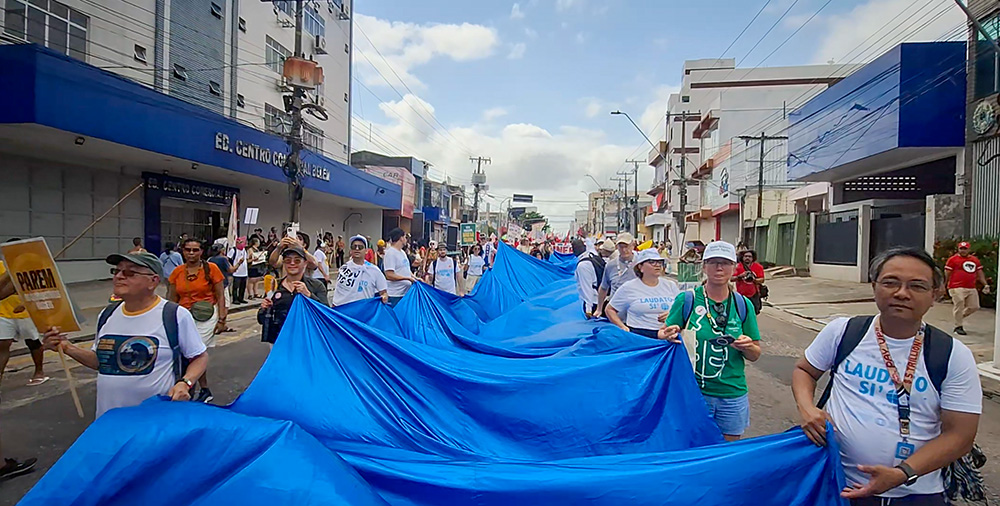
Catholics with the Laudato Si' Movement carry the "River of Hope" banner through the streets of Belém, Brazil, at the global climate march Nov. 15 during the COP30 United Nations climate change conference. (Eduardo Campos Lima)

by Eduardo Campos Lima
A visible Catholic presence was in the middle of the global climate march that drew tens of thousands of people into the streets here over the weekend at the midpoint of the COP30 United Nations climate change conference. It was the first massive public demonstration at a COP in four years.
People from all over the world joined the nearly 3-mile route winding through streets south of the official COP30 venue on Nov. 15. Along its course, they protested fossil fuels, environmental destruction and corporate influence on international decisions, alongside many other topics.
The march was the first at a U.N. climate summit since COP26 in Glasgow, Scotland, as protests were largely barred by state governments during the meetings in Egypt, United Arab Emirates and Azerbaijan. In contrast, two Brazilian government officials — Sônia Guajajara, minister of Indigenous peoples, and Marina Silva, environment and climate minister — took part in the march.
Leading the march in Belém were Indigenous groups coming from different parts of Brazil. They were joined by environmental activists, students, left-wing groups and a sizable faith community representing all parts of the globe.
Franciscan Br. João Paulo Gabriel came from Bebedouro, a city about 1,500 miles south of Belém, to attend COP30 and the People's Summit. A parallel event to the official U.N.-led negotiations, the People's Summit gathered numerous popular movements and organizations in order to provide a countervision and solutions to the climate crisis.
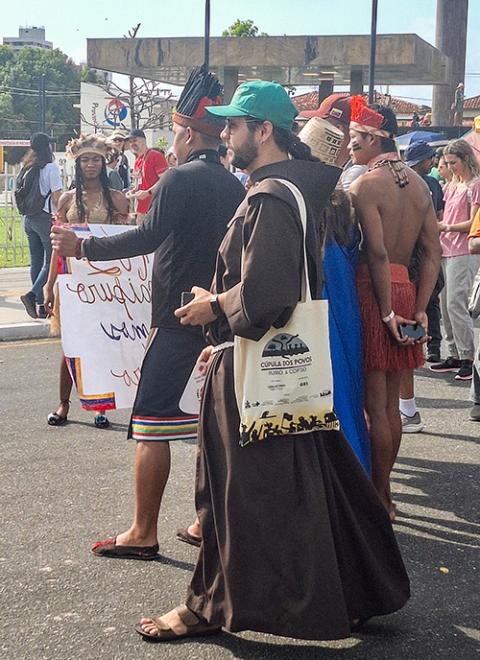
Br. João Paulo Gabriel, a Brazilian Franciscan friar, walks in the climate march Nov. 15 in Belém, Brazil. (Eduardo Campos Lima)
"Franciscans are nationally and internationally mobilized to take part in these events. We're here to struggle for our common home's care, side by side with the invisibilized groups," he told EarthBeat, wearing his Franciscan habit as temperatures soared to 95 degrees Fahrenheit.
Gabriel said he is not very hopeful about the potential measures that the nearly 200 countries may adopt at COP30, but he expects that the events in Belém, including the march, will collaborate to boost awareness among the people regarding the environment.
"We have to leave Belém and keep discussing the need to protect life — not only human life, but all God's creation," he said.
A number of bishops — and even a few cardinals, including Indian Cardinal Filipe Neri Ferrão of the Goa-Daman Archdiocese — also took part in the protest. Joining him was Bishop Maurício da Silva Jardim of the Diocese of Rondonópolis-Guiratinga, Brazil. Jardim, who attended several church events in Belém, made a point of taking part in the demonstration as well.
"The church's presence in the COP30 is a signal of solidarity. We want to say that we're part of the struggle for socioenvironmental transformation, in continuation to [Pope Francis' encyclical] Laudato Si' and [his apostolic exhortation] Laudate Deum," he told NCR.
Jardim affirmed that he sees the march as "a signal of hope."
"We still have time to raise awareness and revert that crisis, which is a climate, economic, and humanitarian crisis," he said.
Advertisement
Most protesters seemed to believe that no significant change would come from the COP30 itself. From the sound trucks leading the march came slogans like: "The real COP is here" and "We're the COP of the people."
Karina Campelo, an activist of the Laudato Si' Movement in the Brazilian city of Recife, agreed with those sentiments.
"Our parallel movement is the true COP," she told EarthBeat. "Among the participants of the official conference there are many companies that have been destroying our planet. And they talk about 'green capitalism.' They're full of fallacies."
She estimated at least 100 people of the Laudato Si' Movement came to Belém from all over the world.
The lay-led movement — created 10 years ago in anticipation of the publication of Francis' encyclical "Laudato Si', on Care for Our Common Home" — formed a distinct bloc during the march. Led by a female stilt-walker, the group carried with them along the route the so-called "River of Hope," a 115-feet-long blue cloth that was used during the "Raising Hope for Climate Justice" conference in October outside Rome. It has made additional appearances as well in Belém.
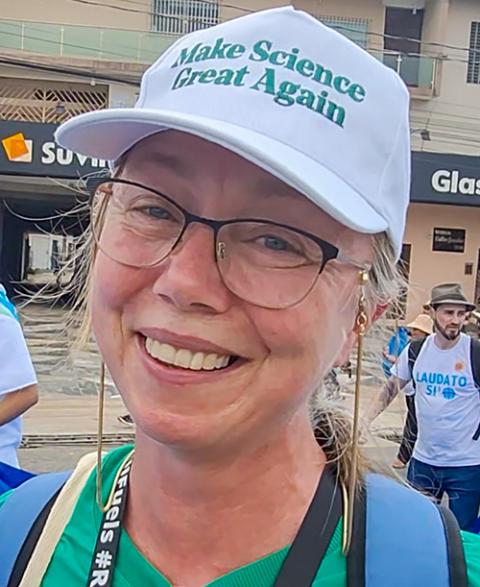
Lorna Gold, executive director of the Laudato Si' Movement, at the global climate march in Belém, Brazil (Eduardo Campos Lima)
"It's phenomenal to see so many church people — from the Catholic Church, but also people from all the different faiths — here on this march," said Lorna Gold, Laudato Si' Movement executive director.
She said the group's message to COP30 is one of climate justice, "but also one of hope."
"We can't afford to lose hope. We have to bring hope and we need to reinforce our hope together," Gold added.
A Scottish-born scholar who holds a doctorate in economic geography and is an expert in sustainable development, Gold affirmed that her goal is to "send a powerful message to the leaders here and the leaders in every country in the world that we want profound change."
"We want to end the influence of the fossil fuel industry over the COPs and we want the people's voice to be heard," she said.
An estimated 1,600 fossil fuel lobbyists are in attendance at COP30, dwarfing the size of most national delegations.
The Laudato Si' bloc at the march was not far from one of the blocs of Indigenous groups, formed by members of the Munduruku people. Numerous Indigenous nations were demonstrating, like the Guarani and the Pataxó. Many arrived as part of a flotilla of 200 boats that opened the People's Summit on Nov. 13.
The major Indigenous demand was for land rights.
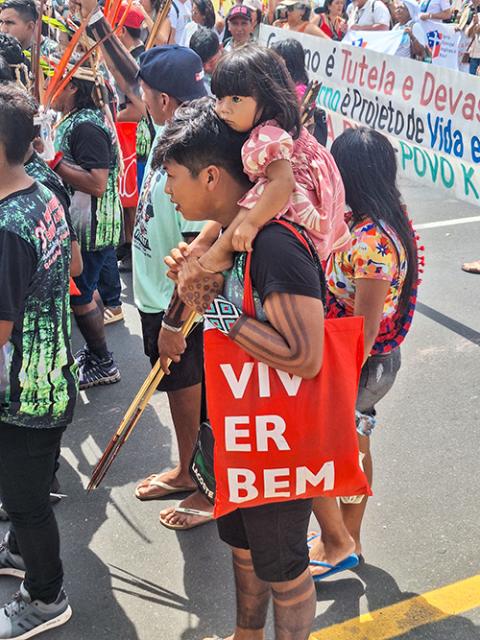
Indigenous groups from different parts of Brazil took part in the global climate march at COP30 Nov. 15 in Belém, Brazil. (Eduardo Campos Lima)
The Brazilian 1988 Constitution established that all traditional territories should be officially granted to their legitimate Indigenous occupiers within five years. So far, only part of that process was concluded, and many Indigenous peoples still do not possess official ownership of their lands.
The Indigenous activists in the march connected the land problem with the climate crisis, arguing that legal uncertainty increases invasions by cattle ranchers, illegal loggers and miners into their ancestral territories, which in turn leads to greater deforestation in the Amazon rainforest.
The Indigenous Pastoral Council (known as CIMI) of the National Conference of Bishops of Brazil accompanies many Indigenous groups in their struggle for land and against intruders. Many CIMI staffers joined the march.
Groups of quilombolas — communities formed by the descendants of enslaved Africans who fled captivity during the slavery era in Brazil (1500-1888) and settled in remote areas — were also marching and demanding land grants.
Despite the atmosphere of mistrust concerning the international negotiations at COP30, some of the activists marching for the environment saw both dimensions as equally valuable.
"We cannot lose hope concerning the official event. The two fronts complement each other," Walter Prysthon, a French Caritas official who was born in Brazil, told NCR.
Prysthon, who attended other COPs in the past, said he's hopeful about a climate action road map to be released at the end of the event.
"In order to be effective, that road map needs social mobilization. That's why it's fundamental for us to be here protesting," he said.