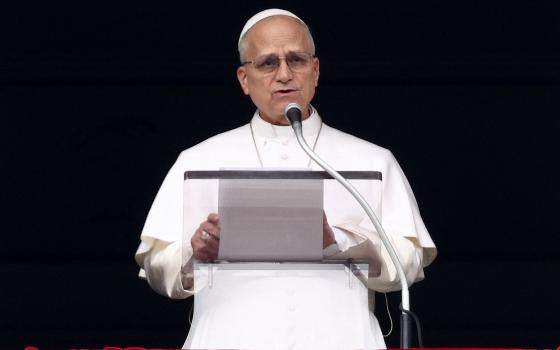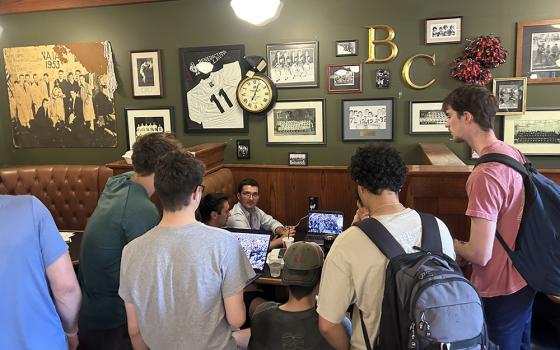
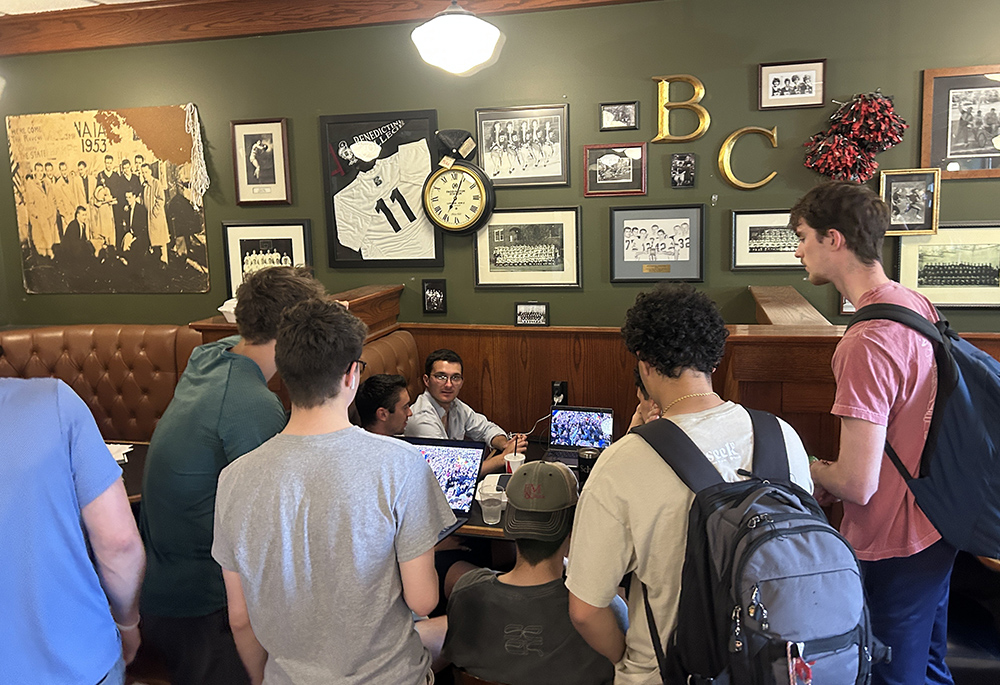
Students at Benedictine College in Atchison, Kansas, watch the announcement of a new pope at a coffee shop May 8. Chicago-born Cardinal Robert Francis Prevost was elected as the next pope and he chose the papal name Leo XIV. (OSV News/Jack Figge)

by Patricia Zapor
A new study shows that a majority of Catholic college and university students say they are informed about the news, which they get primarily through social media, TV or online videos. Only a small percentage read the news daily.
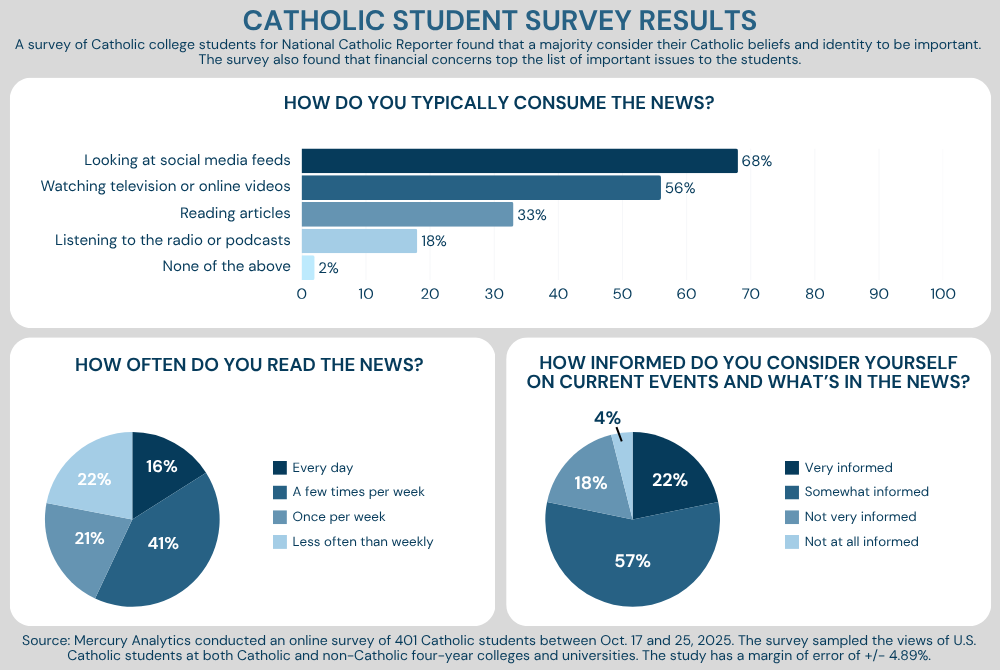
According to data from a survey that measured the views and behavior of Catholic college students in their relationship with Catholicism, politics and news consumption, 78% of these students say they are very or somewhat informed about news and current events, though just 16% read news daily. Forty-one percent said they read news a few times a week and 22% said they do so less often than weekly.
The survey was conducted for the National Catholic Reporter and the Wittcoff Foundation, a philanthropic group that supports health, education and climate action initiatives.
The students' top ways to consume news were looking at social media feeds or watching television or online videos, with some noting in comments additional information such as: "sometimes reading is boring," and "I feel like I have a better attention span when I'm watching a video."
The NCR/Wittcoff Foundation Survey of Young Catholics polled 401 Catholic students at Catholic and non-Catholic four-year colleges and universities. It was conducted online Oct. 17-25 by Mercury Analytics, a Virginia-based custom research company that regularly surveys the public for organizations including news outlets and nonprofits.
For more about the survey's methodology, click here.
For more detail from the survey results, see the file below.
For the most part, the responses to the survey differed little whether the students were in Catholic or non-Catholic colleges. On a few topics, such as how often they receive the sacraments, the responses differed quite a bit.
When asked about news consumption, some of the biggest differences were in what sources they use and on what topic they said they regularly follow.
The largest percentage, 60% of the respondents, said they regularly follow U.S. politics. Forty-one percent of the entire group listed professional sports second most frequently. Forty-five percent of the students at Catholic colleges listed faith and religion as a topic they regularly follow, compared to 27% of the non-Catholic institution students.
Between 25% and 38% of the respondents mentioned they follow news on health and wellness; science and technology, celebrities, international politics and faith and religion.
Social media feeds were listed by 68% of the entire group as their typical source for news, followed by 56% who said they watch television or online videos. Just 33% said they read articles and 18% said they listen to the radio or podcasts. Somewhat more Catholic university students said they watch television or online videos, 64%, compared with 54% of students at non-Catholic institutions. Seventy percent of students at non-Catholic institutions said they consumed news by looking at social media feeds, compared to 60% of Catholic university students.
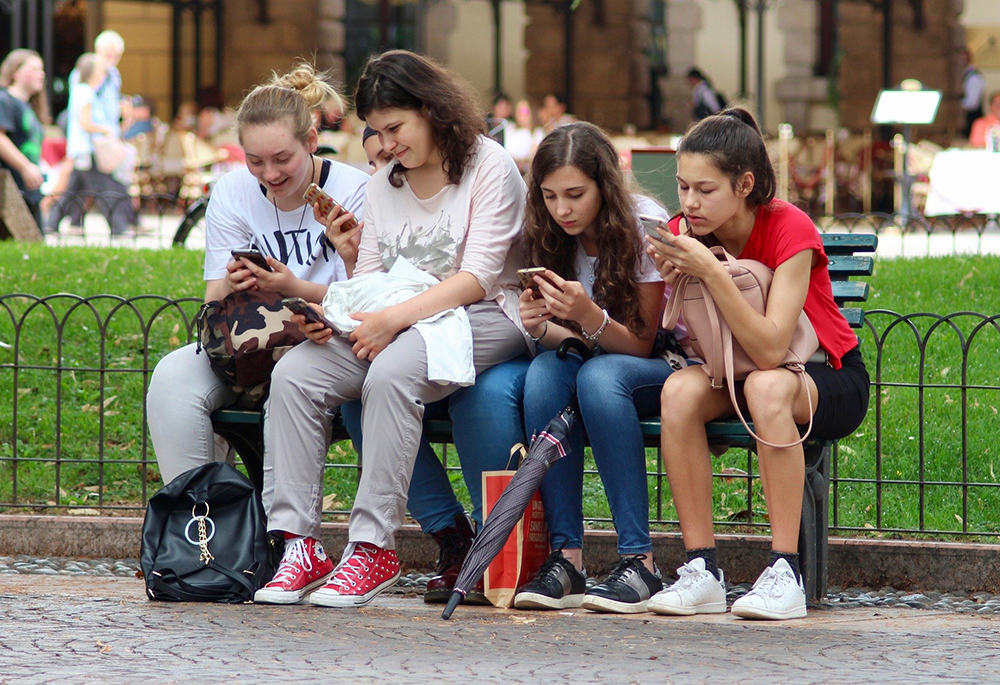
A group of young women sit together while on their smartphones in this undated photo. (OSV News/Pixabay/Gary Cassel)
A handful of participants listed who they follow in social media. Recurring names included Candace Owens and Charlie Kirk, the founder of Turning Point USA who was killed after being shot at a public appearance on Sept. 10. Others mentioned sources such as late-night television hosts Jimmy Kimmel, Stephen Colbert and Jimmy Fallon, or the Comedy Central network.
TikTok, followed closely by Instagram, were listed as their typical news sources by respondents. Fifty-six percent listed TikTok, 52% listed Instagram and 45% listed YouTube.
One point of divergence by type of school was that 44% of Catholic university students listed Twitter/X as a typical source, compared with 29% of those at non-Catholic schools. The latter group also was more likely to rely on Instagram; 54% listed it, while 41% of their Catholic institution counterparts included Instagram.
There was less than a 10% point difference between the two types of students in their inclusion of all other news sources, including those such as Fox News and MSNBC, which are often seen as politically polarizing.
Advertisement
Rosie Chinea Shawver, executive director of the Catholic Campus Ministry Association, said the heavy lean on short-form video is exactly what she sees in her own family. It suggests that Catholic institutions would be well served by producing more short-form videos in their messaging, she said.
One student in the survey commented: "I prefer watching a video because it is easier to digest the content and it is more exciting than reading an article. I typically will never finish an article but will finish a video."
Shawver lauded a statement released by the U.S. Conference of Catholic Bishops a few days earlier as an example.
After passing a written statement Nov. 12 about the impact of immigration enforcement, a short video was posted by the bishops' conference to accompany the statement.
"That's an example of doing it really well," Shawver said.