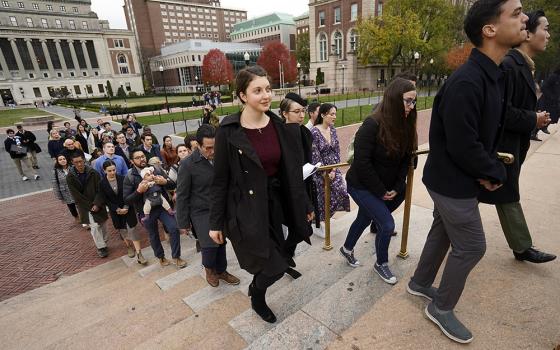
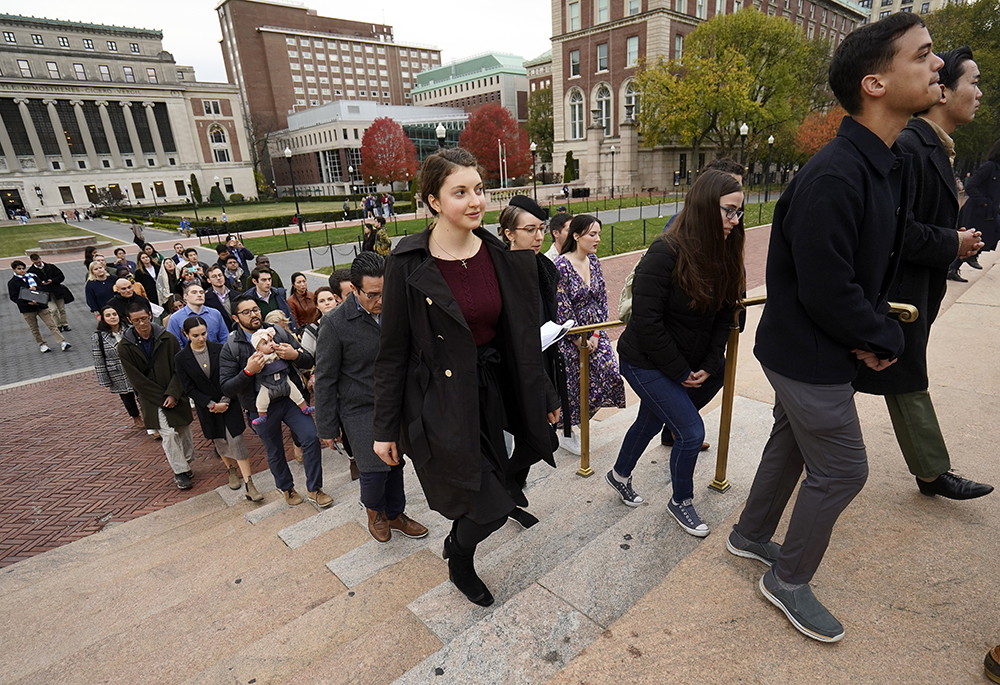
Members of the Catholic campus community at Columbia University in New York City participate in a Eucharistic procession on campus Nov. 10, 2024. A survey conducted for the National Catholic Reporter and the Wittcoff Foundation said that a majority of U.S. Catholic college and university students are engaged with their Catholic beliefs and identity. (OSV News/Gregory A. Shemitz)

by Patricia Zapor
Students at Catholic higher institutions place more of an emphasis on church activities — including going to Mass, receiving sacraments, participating in community service and following the church on social media — than students at non-Catholic colleges and universities, according to a new survey.
A survey conducted for the National Catholic Reporter and the Wittcoff Foundation also said that a majority of U.S. Catholic college and university students are engaged with their Catholic beliefs and identity, with 8 in 10 Catholic students indicating they are currently involved with the church.
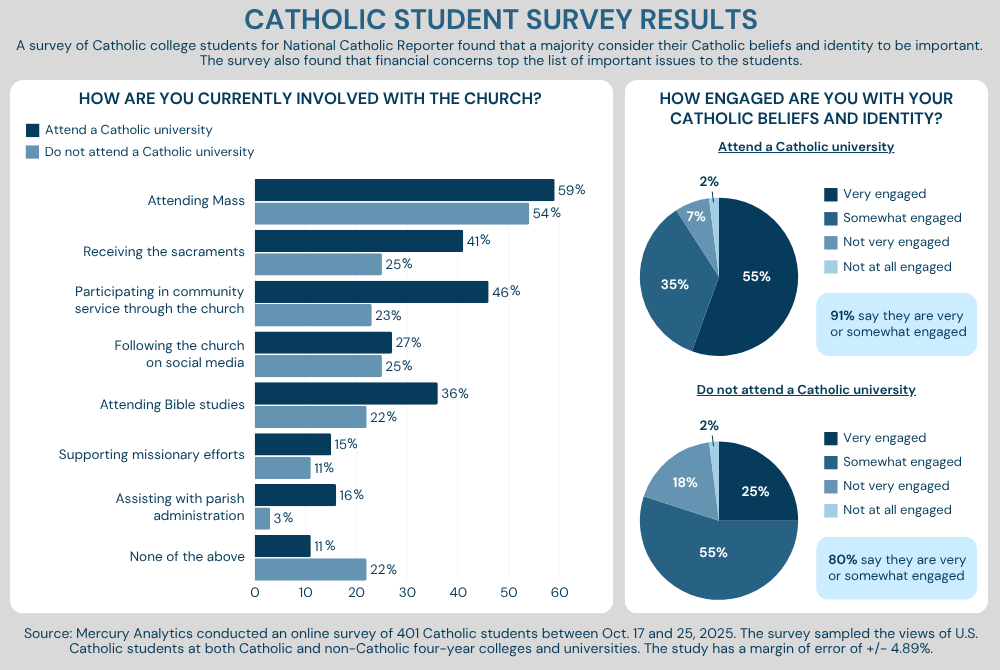
The NCR/Wittcoff Foundation Survey of Young Catholics found that students at non-Catholic colleges and universities were less likely to say they understand Catholic social teaching and social justice, although they had similar priorities with students at Catholic colleges on societal issues.
The survey polled 401 Catholic students in both Catholic and non-Catholic four-year colleges and universities. It was conducted online Oct. 17-25 by Mercury Analytics, a Virginia-based custom research company that regularly surveys the public for organizations including news outlets and nonprofits. The Witcoff Foundation is a philanthropic group that supports health, education and climate action initiatives.
The heads of two nonprofits that represent Catholic colleges and campus ministers said they found some encouraging news in the data.
For more about the survey's methodology, click here.
For more detail from the survey results, see the file below.
In the overall group, 65% said they are very or somewhat familiar with Catholic social teaching and social justice, while 87% of those at Catholic institutions and 59% at non-Catholic schools gave those answers.
The students at the different types of schools answered similarly, however, when asked to name the elements of Catholic social teaching. By similar percentages, they selected "helping the poor and the sick"; "caring for the environment"; "helping the immigrant"; and "protecting unborn life" as the key elements.
The survey found that similarly high percentages of the students at both types of colleges said their Catholic beliefs and identity are important. But more students at church-affiliated schools said those are "very important," (69% at Catholic schools and 43% at non-Catholic schools) versus "somewhat important" (26% at Catholic schools and 46% at non-Catholic.)
Rosie Chinea Shawver, executive director of the Catholic Campus Ministry Association, a professional organization for 700 members who work at more than 966 college campuses, said the survey's data reflects "what we are seeing in the pews."

Students from the College of St. Benedict in St. Joseph, Minnesota, and St. John's University in Collegeville, Minnesota, attend Mass Feb. 20, 2022, on the frozen ice of Lake Sagatagan on St. John's campus. (CNS/Courtesy College of St. Benedict and St. John's University)
Shawver said the level of engagement with religion is reflected anecdotally by booming enrollment on some campuses in the Order of Christian Initiation for Adults, or OCIA, the program to guide people who are interested in becoming Catholic.
She said the OCIA program at Texas A&M University has more than 400 participants, and at the University of Maryland, "so many students are coming they need to add another Mass to the schedule."
Half of the respondents from Catholic colleges said they consider attending Mass to be a part of their college life, compared to 42% of those at non-Catholic institutions. Thirty-nine percent of the former group also listed participating in community service through the church, being in a Bible study, 36%, or receiving sacraments, 28%, as part of their college experience. Fewer than 20% of the students at non-Catholic schools listed any of those activities as part of their college life.
Donna M. Carroll, president of the Association of Catholic Colleges and Universities, said she also is hearing about booming classes of OCIA at Catholic institutions. "Just recently, one president told me that over three years his [OCIA] numbers went from under 10 to over 100, so a campus culture that encourages faith formation has impact, especially in our current fractured and morally challenging time."
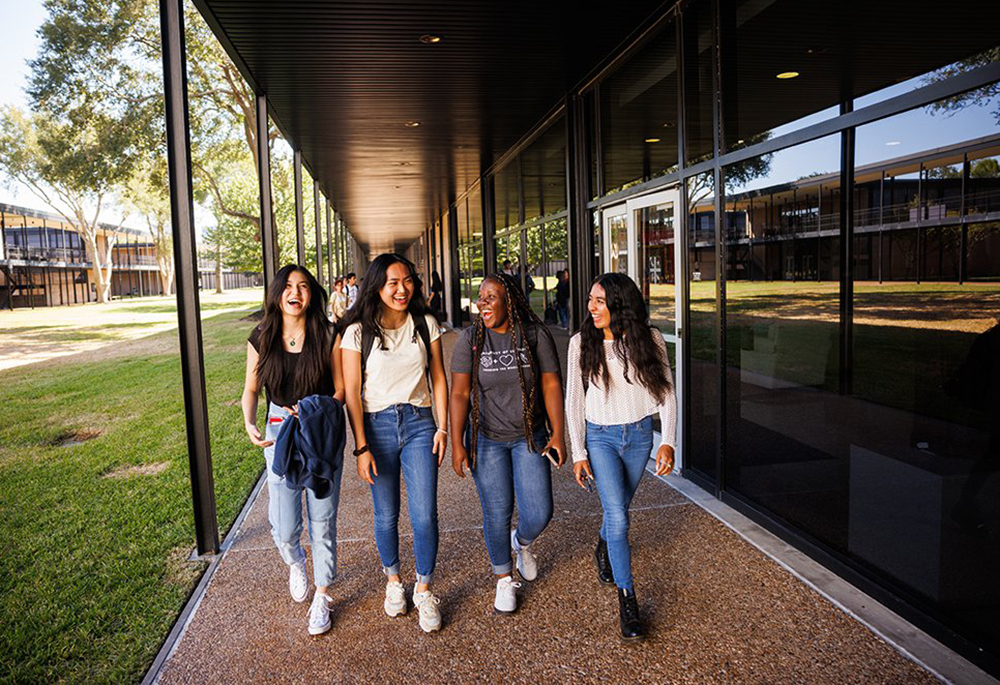
Students on the University of St. Thomas campus in Houston, Texas, are pictured in this undated photo. (OSV News/Courtesy of University of St. Thomas)
More than half of the Catholic school students, 55%, said they are "very engaged" with their Catholic beliefs and identity, compared to 25% of students at other types of colleges.
Asked about what issues are important to them personally, the Catholic college students and non-Catholic students had some differences in what issues they listed, but overall, their responses fell within a few percentage points of each others' answers. The issue listed most by the Catholic school students, 61%, was the cost of higher education/student loan debt. Fifty-eight percent listed cost of living; 56% said affordable housing and 53% listed mental health. Among students at non-Catholic colleges, the cost of living had the most responses, 68%; followed by affordable housing, 62%; cost of higher education/student loan debt, listed by 61%; and mental health, listed by 56%. "Reproductive rights/abortion" was named by 48% of students at Catholic colleges and 43% of non-Catholic school students.
The topic of religion as a priority had a more significant gap: 52% of those at Catholic institutions included this as an issue important to them personally, while 38% of those at non-Catholic schools listed it.
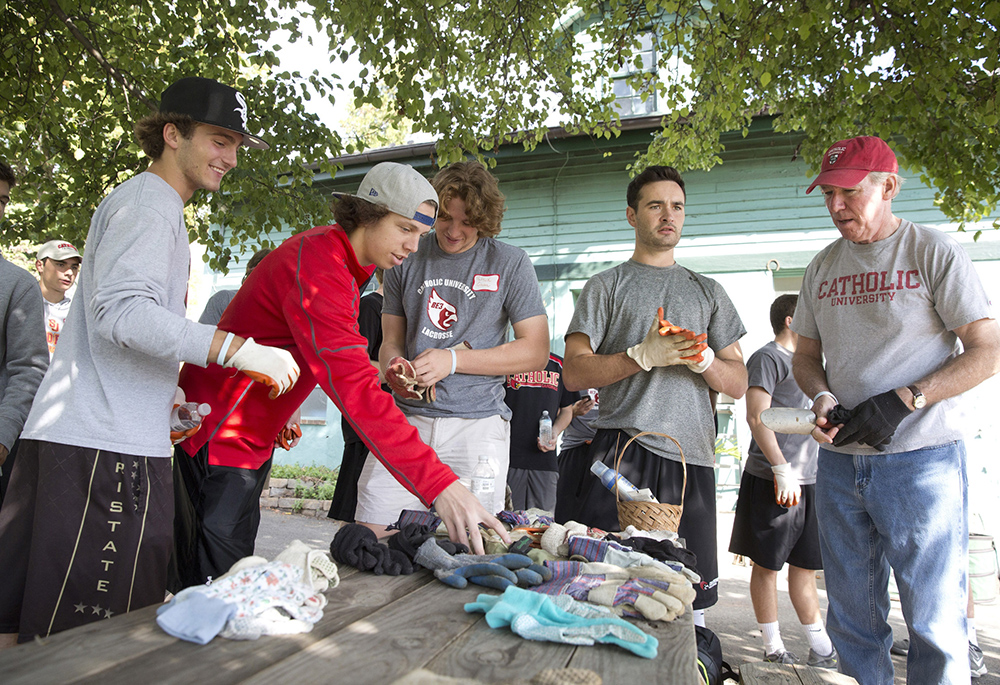
John Garvey, former president of The Catholic University of America, right, and student volunteers are pictured in the garden at the Franciscan Monastery in Washington Sept. 13, 2015 during a day of service in advance of Pope Francis' visit to Washington and Mass he was to celebrate on the grounds of the university. (CNS/Catholic Standard/Jaclyn Lippelmann)
A question about which topics the respondents consider "Catholic issues" also showed some divergence between students at different schools. Both groups were most likely to list "religion" as a part of their faith (62% at Catholic schools and 56% at non-Catholic institutions), but from there, differences emerged. Fifty-two percent of Catholic university students listed "reproductive rights/abortion" as part of their faith, compared to 37% of those at non-Catholic schools.
Besides religion and "reproductive rights/abortion," none of the options for faith-related issues were included by more than 40% of the students in either group. Forty percent of the Catholic school students listed mental health as a Catholic issue or part of their faith.
Advertisement
Carroll said she wasn't surprised by data that showed Catholic university students were more engaged in their faith.
"In a Catholic institution, Catholic students experience their faith being reinforced by programs, symbols and rituals," she said. "Students are invited to integrate the intellectual and the spiritual, which is 'welcoming' not only to Catholic students but to students of other religions that choose to attend a faith-based institution. There is a social element too — finding shared values and aspirations."
Shawver said the data showing modest differences between students at Catholic versus non-Catholic colleges, particularly about their understanding of Catholic social teaching, "is not insignificant." It tells her that "the need to integrate Catholic social teaching is really high."
She also said she wasn't surprised by the societal priorities the surveyed students listed, noting that the answers are similar to what other studies have found from all contemporary college students. Their worries about the cost of living and affordable housing are "a very big deal" on many campuses, she said.