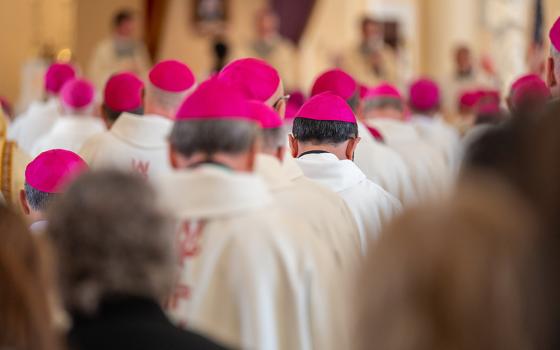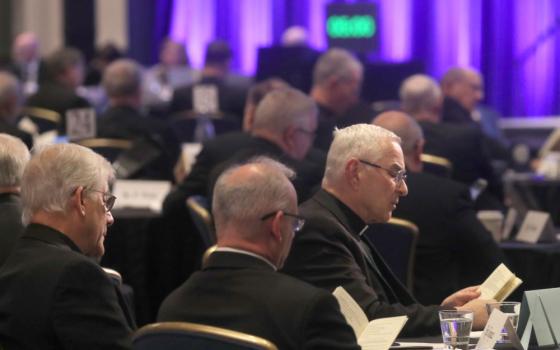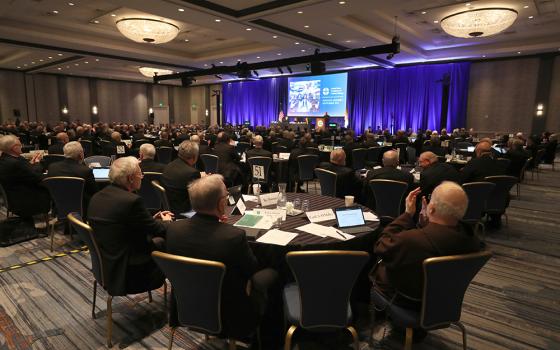
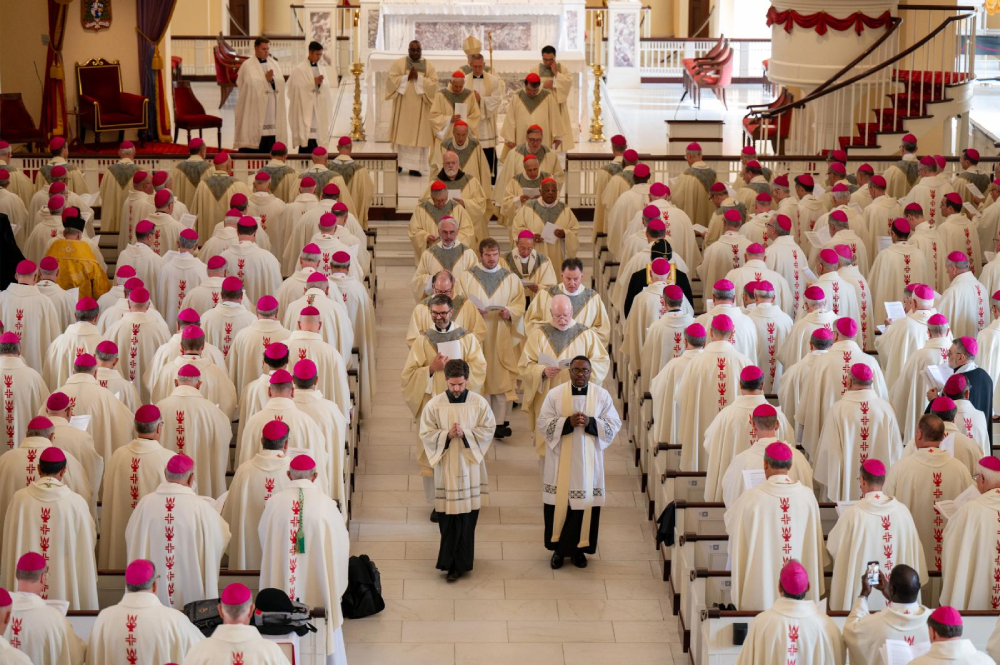
Bishops from around the country gather at the Basilica of the National Shrine of the Assumption of the Blessed Virgin Mary in Baltimore Nov. 11, 2024, for the opening Mass of the U.S. Conference of Catholic Bishops' 2024 fall plenary assembly. (OSV News/Catholic Review/Kevin J. Parks)
by Brian Fraga
Staff Reporter
Amidst a polarizing political climate, the U.S. Conference of Catholic Bishops will gather this week in Baltimore to choose new leaders for the conference and discuss matters that include immigration enforcement and the ethical directives for Catholic health care facilities.
The bishops' agenda for its Nov. 10-13 fall plenary assembly promises to be eventful, with speeches from Cardinal Christophe Pierre, the Vatican's ambassador to the United States, and Archbishop Timothy Broglio of the Archdiocese for the Military Services, USA, who will deliver his final address as conference president.
Behind closed doors in executive session, the bishops are expected to discuss the ongoing implementation of the Synod of Bishops on Synodality as well as best practices for the ongoing instruction of Laudato Si', Pope Francis' 2015 encyclical on ecology.
In addition, the bishops will elect chairmen of six conference committees. They will vote to approve liturgical texts and the scheduling of the next National Eucharistic Congress in 2029. The bishops will also vote on a proposal to consecrate the United States to the Sacred Heart of Jesus on June 12, 2026, as part of the celebration of the U.S. Semiquincentennial.
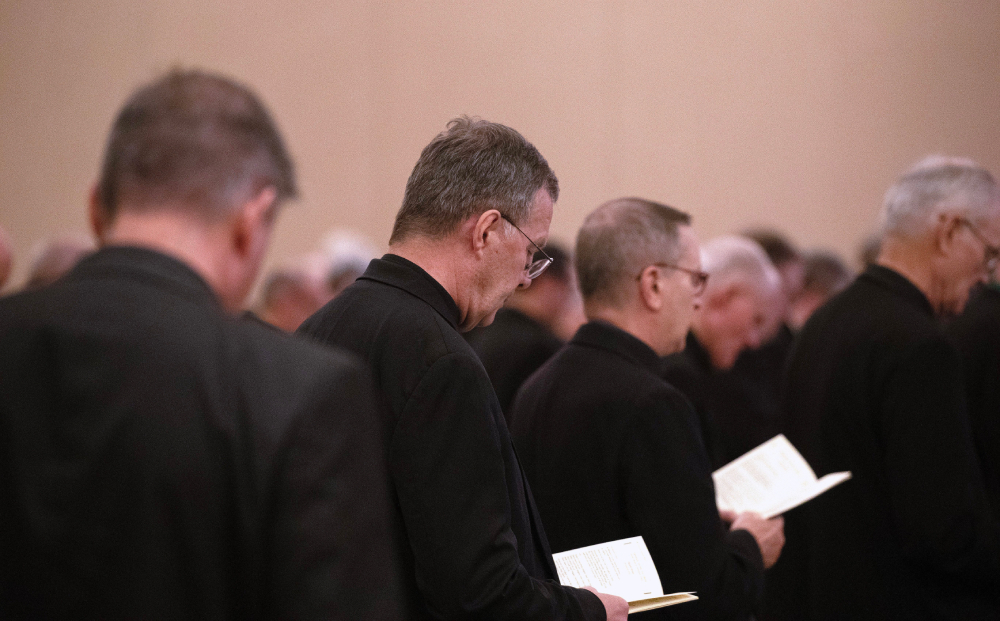
Bishops pray June 13, 2024, at the U.S. Conference of Catholic Bishops' spring plenary assembly in Louisville, Ky. (OSV News/Bob Roller)
The following are expected to be the more consequential items on the itinerary in Baltimore.
Elections for president
The choice of a new president for the U.S. bishops' conference will be "the most important" moment for U.S. Catholicism since the conclave in May that elected the U.S.-born Pope Leo XIV, said Massimo Faggioli, a church historian and ecclesiology professor at Trinity College Dublin.
Faggioli, who has studied and written about the American hierarchy, told the National Catholic Reporter that the pope has invited the U.S. bishops in recent weeks to do their part to deal with "the particular American situation," especially on matters pertaining to immigration. The election will give observers an indication of whether the conference is prepared to heed Leo's call.
"The most important criterion is whether the conference chooses someone who can receive pope Leo's invitation courageously or someone that will be selective and more sensitive to domestic political-partisan concerns," Faggioli said.
"In these days, the USCCB is looked at with particular attention by many Catholics and church observers around the world," Faggioli added. "It's an election that will have consequences beyond the U.S. church."
For the position of president, the bishops will choose from a slate of 10 candidates. The candidate who receives a simple majority vote of the members present is elected president, as long as he receives more than half of the votes cast. Following the election of the president, the vice president is elected from the remaining nine candidates.
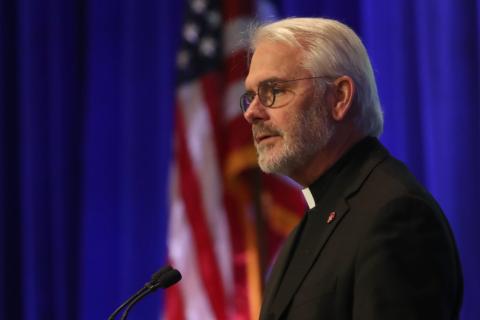
Archbishop Paul Coakley of Oklahoma City, chair of the U.S. bishops' Committee on Priorities and Plans, speaks during a Nov. 13, 2024, session of the fall general assembly of the U.S. Conference of Catholic Bishops in Baltimore. (OSV News/Bob Roller)
Observers consider the two leading candidates for president to be Oklahoma City Archbishop Paul Coakley and Bishop Daniel Flores of Brownsville, Texas. Winona-Rochester, Minnesota, Bishop Robert Barron, a well-known cleric with a robust multimedia platform, is a potential wild-card candidate.
The other candidates include: Archbishop Richard Henning of Boston; Bishop David Malloy of Rockford, Illinois; Archbishop Nelson Pérez of Philadelphia; Bishop Kevin Rhoades of Fort Wayne-South Bend, Indiana; Archbishop Alexander Sample, of Portland, Oregon; Archbishop Charles Thompson of Indianapolis; and Archbishop Edward Weisenburger of Detroit.
Coakley, 70, the current conference secretary, is the ecclesiastical advisor to the NAPA Institute, a conservative-leaning organization that often showcases a blend of personal piety and right-wing politics at its annual summer conferences.
In 2018, Coakley was also among several American bishops who expressed support for Archbishop Carlo Maria Viganò after the former Vatican ambassador to the United States accused Pope Francis of covering up sexual abuse and called on the pope to resign. Viganò has since been excommunicated. Coakley has not retracted his statement where he expressed his "deepest respect" for Viganò's "personal integrity."
Coakley's "support of Viganò is certainly a failure of judgement on his part," said Fr. Thomas Reese, a Jesuit priest and journalist who has covered the bishops' conference for decades.
"You need someone as president of the conference where there is no doubt about their loyalty to Popes Leo and Francis," Reese said.
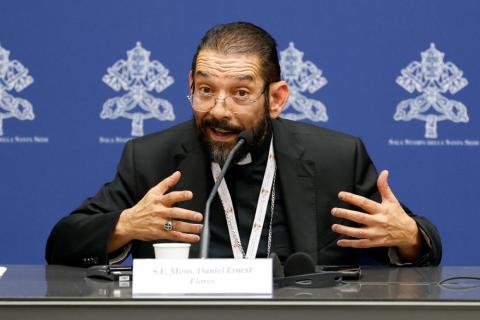
Bishop Daniel E. Flores of Brownsville, Texas, speaks during a briefing about the assembly of the Synod of Bishops at the Vatican Oct. 19, 2023. (CNS/Lola Gomez)
If Flores, 64, is elected president, Reese said it would indicate that the bishops want the conference to be forceful on immigration since Flores, whose Texas diocese borders Mexico, has been vocal on the issue over the years. Flores also oversaw the conference's operations on the Synod of Bishops on Synodality.
"He would be seen as someone who can connect with Pope Leo and is in continuity with Pope Francis," Reese said.
Discussion on immigration
An Oct. 22 media advisory from the bishops' conference announced that the prelates' Nov. 11-12 public session will include "a discussion and response to the evolving situation impacting migrants and refugees."
Several individual bishops have already issued strongly-worded statements and homilies criticizing the Trump administration's aggressive immigration enforcement tactics. Those outspoken prelates include Cardinals Blase Cupich of Chicago and Robert McElroy of Washington D.C., Weisenberger, as well as Bishops Mark Seitz of El Paso, Texas, and Joseph Tyson of Yakima, Washington, among others.
In his capacity as conference president, Broglio offered a reflection in June on the situations facing migrants: "As your shepherds, your fear echoes in our hearts and we make your pain our own. Count on the commitment of all of us to stand with you in this challenging hour."
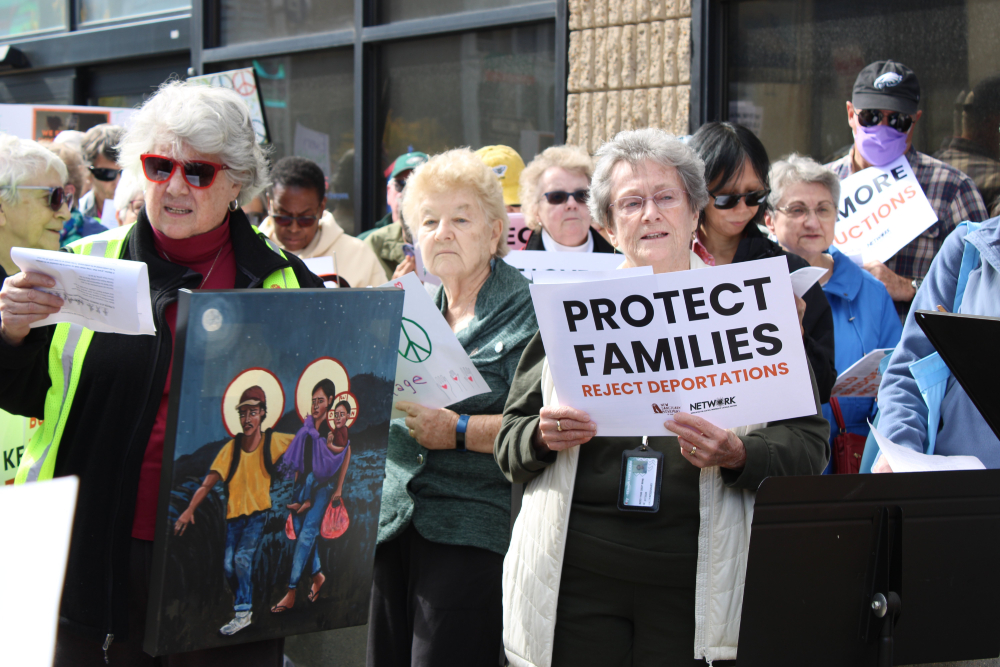
Participants gathered Oct. 22, 2025, in front of the U.S. Immigration and Customs Enforcement offices in Philadelphia as part of the nation-wide "One Church, One Family" prayer vigils organized by the Jesuits West province and several Catholic organizations, including the U.S. Conference of Catholic Bishops' Migration and Refugee Services, to protest mass deportations and promote pastoral accompaniment for immigrants lacking permanent legal status in the U.S. (OSV News/Gina Christian)
Speaking as the chairman of the bishops' migration committee, Seitz on Oct. 31 responded to the Trump administration's announcement that it was severely restricting the admittance of new refugees into the United States.
"We cannot turn a blind eye to the disparate treatment of refugees currently taking place," Seitz said.
Other bishops across the country have also released statements expressing support for migrants and refugees. The discussion at the conference's plenary session provides an opportunity for the prelates to speak on the matter with a unified voice, said Reese.
"We've had some stuff come out of the committee chairs on immigration, but that doesn't have the force of the whole body of bishops saying something. This is the chance for them to do something like that," Reese said.
But the question is, how strong do the bishops want to be in taking on the Trump administration for its tactics on immigration enforcement?
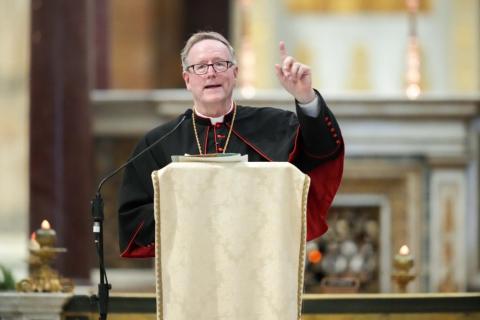
Bishop Robert E. Barron of Winona-Rochester, Minnesota, gives the keynote address during the USA National Jubilee Pilgrim Gathering at the Basilica of St. Paul Outside the Walls in Rome July 30, 2025. (CNS/Lola Gomez)
While some bishops have been outspoken on current migration matters, others have pulled their punches when it comes to criticizing the federal government. For example, Barron took to social media on Nov. 6 to publicly stipulate that he did not criticize the Trump administration in advocating that migrants in federal custody have access to the sacraments.
"I think the fear is that the Trump administration is so vindictive that if [the bishops] make a big fuss, Trump will tell his subordinates to make sure that no Catholic organizations receive federal contracts," Reese said. "With this president, that's a reasonable fear."
Faggioli said he believes the bishops are divided on how much the federal government should be left undisturbed in its tactics on immigration enforcement, and on how much the church can speak on this issue.
"Maybe some bishops have unconsciously decided that a government hostile to the demands of the church for a more humane treatment of migrants and refugees is the price to pay for a return of religion in American public life," Faggioli said.
Ethical and religious directives
In their public session, the bishops will also discuss and vote on the revised text of the Ethical and Religious Directives for Catholic Health Care Services.
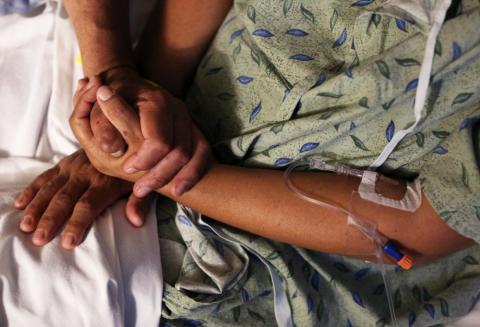
A hospital patient is comforted by a family member in this illustration photo. (CNS/Reuters/Caitlin O'Hara)
The revised directives, which are described as the "authoritative guidance" for U.S. Catholic health care institutions, will mandate that Catholic facilities not provide gender-affirming medical treatment to transgender patients.
In the revised directives, a copy of which was provided to NCR, Catholic health care institutions are instructed not to perform any medical interventions "that aim to transform sexual characteristics of a human body into those of the opposite sex."
Catholic health care institutions are called upon to "employ all appropriate resources to mitigate the suffering of those who experience gender incongruence or gender dysphoria," while only using means "that respect the fundamental order of the human body."
If patients or their surrogates request medical interventions not in accord with the church's moral teachings, then Catholic health care professionals will not be permitted to refer them to another professional for the purpose of obtaining those interventions, according to the revised directives.
Advertisement