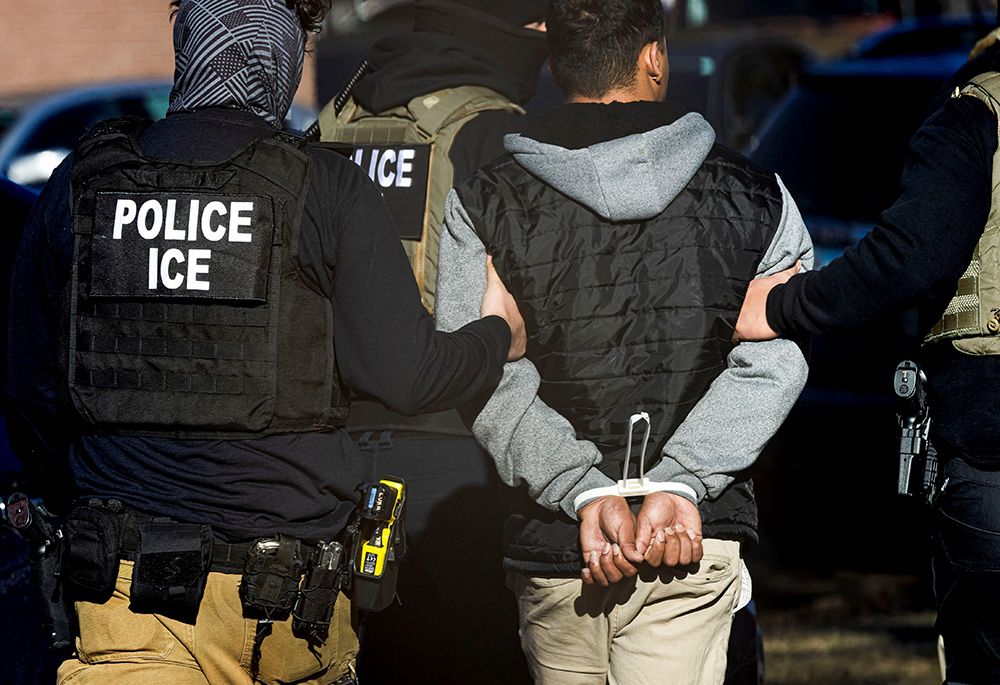
Agents with the Immigration and Customs Enforcement detain a man after conducting a raid at the Cedar Run apartment complex in Denver Feb. 5, 2025. (OSV News photo/Reuters/Kevin Mohatt)
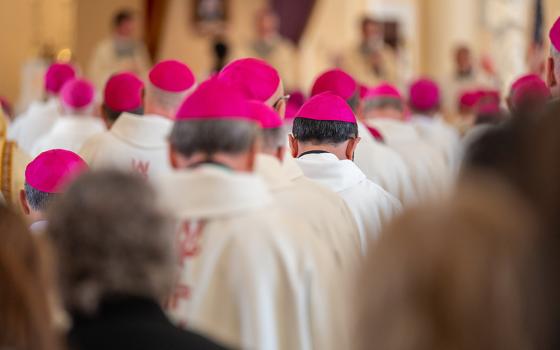
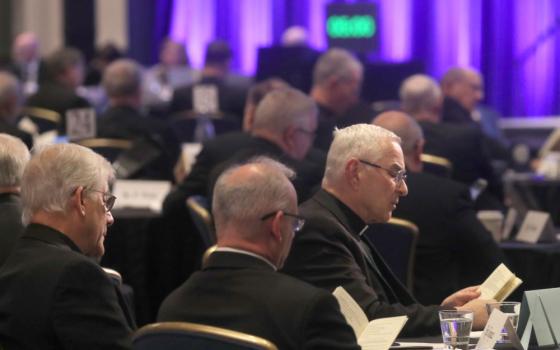
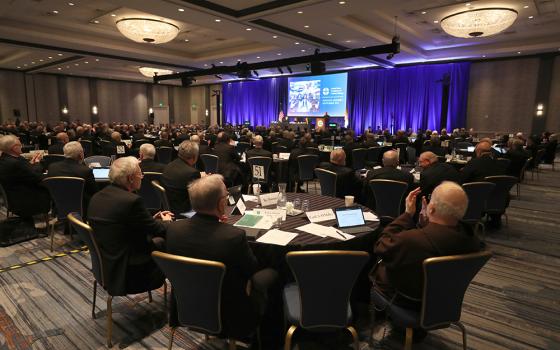
What the nation's Catholic bishops, gathered this week in Baltimore, choose to say or not say could hold no less weight than what it means to be Catholic in the United States at this moment.
Much attention is focused on who will be elected president of the bishops' conference. Will the selection lean liberal? Will it be one of the loud culture warriors? Will it be a seeker of celebrity? Someone in the middle?
All that may be important in the short term of episcopal politics, but whether they can manage to say something of significance, as a body, to the current crisis in our national politics will have far more importance for the long haul. The bishops have had a year to witness the Trump administration eliminate funds and food to the world's most desperate populations.
They have witnessed the cutoff of medications for HIV and other dangerous diseases to extremely vulnerable populations.
They have watched as masked, unidentified, heavily armed thugs without warrants tear apart segments of the Catholic community, often with no more reason than a person's skin color and accent.
They have watched families torn apart, parents separated from children, men sent to torture prisons in foreign countries without due process.
What we are witnessing is clearly contradictory not only to the heart of the Christian Gospel, but to the essence of other world religions as well.
A few of our Catholic leaders have spoken out strongly, a few have acted. A few statements have wafted out of the building housing the U.S. Conference of Catholic Bishops. But for an organization that spent untold millions over decades to influence national politics on a single life issue, the response to real terror in our streets and government-driven deprivation of basic needs has been embarrassingly inadequate.
What does it mean, then, to be a Catholic today in these United States?
Figuring out exactly how to fit into a pluralist democratic republic has never been an easy task for the Catholic Church. No simple formula exists. The relationship, unnatural at the start for those escaping monarchies, changes era to era.
Alexis de Tocqueville in 1831 wrote that Catholics were erroneously seen as "the natural enemy of democracy," and they would instead be quite compatible with the notion of equality. But today's Catholic community is no longer, as de Tocqueville then saw it, "composed of only two elements: the priest and the people. The priest alone rises above the rank of his flock, and all below him are equal."
It's not that simple anymore. The church of today is a cultural power in many ways, with its members inhabiting the highest offices in the land, including the most recent past president, the current vice president and a majority on the Supreme Court. Its members are influencers, bearers of enormous wealth, powerful manipulators of politics and commerce and the church itself.
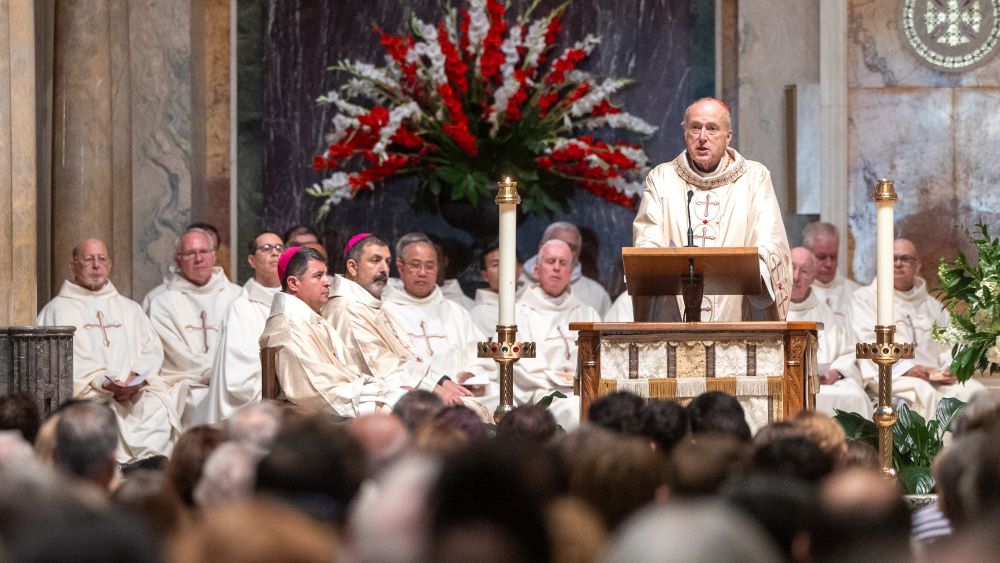
During his homily at a Mass marking the 111th World Day of Migrants and Refugees on Sept. 28 at the Cathedral of St. Matthew the Apostle in Washington, Cardinal Robert McElroy blasted "a comprehensive governmental assault designed to produce fear and terror." (OSV News/Mihoko Owada, Catholic Standard)
But its members also include millions of immigrants from all over the world seeking refuge here, who are finding their lives disrupted by the current whims of political power. They are the victims, as Washington, D.C., Cardinal Robert McElroy recently put it, of "a comprehensive governmental assault designed to produce fear and terror among millions of men and women who have through their presence in our nation been nurturing precisely the religious, cultural, communitarian and familial bonds that are most frayed and most valuable at this moment in our country's history."
One of the most difficult realities to acknowledge in this moment is the deliberate cruelty being visited on people by the government. What we face today is not a matter of individuals transgressing a single church teaching. This is a state-ordered and planned malignancy of foundational democratic ideals and previously agreed upon ideas of the common good. What is being done in our name is not a matter of policy over which there can be disagreement; it breaks through the partisan silos that have divided us. What we are witnessing is clearly contradictory not only to the heart of the Christian Gospel, but to the essence of other world religions as well.
Catholics in the United States have always been a cantankerous lot, free to disagree on public issues, the sweet popular myth of unyielding unity notwithstanding. But through difficult issues — from slavery to war to economic principles — there has been a certain consistency to American Catholicism. That consistency was often the result of the wisdom of the collective episcopacy, though their words may have gone unheeded by segments of the community.
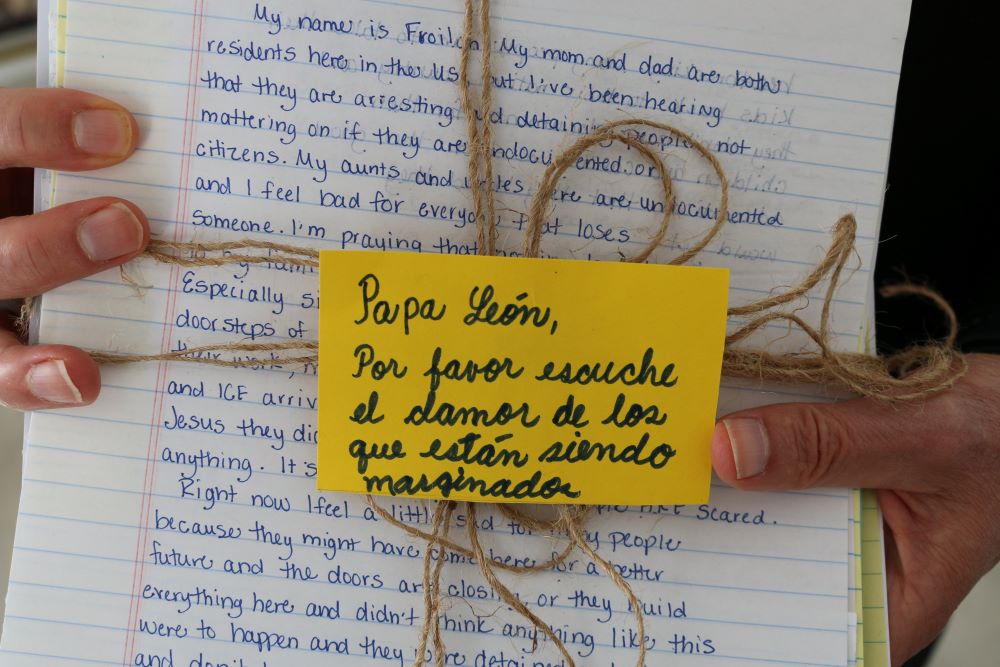
Bishop Mark Seitz of El Paso, Texas, holds a bundle of letters to Pope Leo XIV from migrants in the United States before presenting them to the pope Oct. 8. The note, in Spanish, says, "Pope Leo, please listen to the cry of those who are being marginalized." (CNS/Courtesy of Hope Border Institute)
What are today's words? What is the wisdom?
The questions are especially compelling in the current circumstance precisely because this does not involve a single issue, nor is it an uncomplicated matter of church vs. state. One of the highest officials in the land, Vice President JD Vance, a recent convert to Catholicism, is one of the leading apologists for and architects of the cruelty that we see playing out in many of our Catholic communities. He is apparently in need of serious instruction on the articulation of Catholic social doctrine, developed papacy after papacy, for the past 134 years.
Dare the bishops call him to account?
Many others influential in the current assaults on democratic norms and decisions about cutting off essential aid to the most vulnerable and needy are public Catholics. Is it possible that the architects of the cruelty and those who run Catholic agencies desperately pleading for help to stem the cruelty are each correct representatives of the faith?
We are quite aware of how the bishops have compromised their credibility and misspent their political capital in recent decades. They might shrink from the demands of the moment, yielding to the feeling of cultural irrelevance. They can't entertain that luxury.
Advertisement
Catholics understand sin, forgiveness and the moral urgency that sometimes calls us, even the weakest among us, to extraordinary action.
This is one of those moments.
The demands of this moment are not yet as great as those faced by some we have put on the path to sainthood: Dorothy Day, who was arrested multiple times and even imprisoned for her stands against what she perceived as assaults on the Gospel; Salvadoran Archbishop Oscar Romero, martyred for speaking out against state violence and corruption; Franz Jagerstatter, the Austrian farmer executed for refusing to join the Nazi cause.
God has not called us to such extremes, but their example invites us to summon the courage required for this time.
Bishops, what are the words? What is American Catholicism in this moment of political crisis?
Silence is consent.