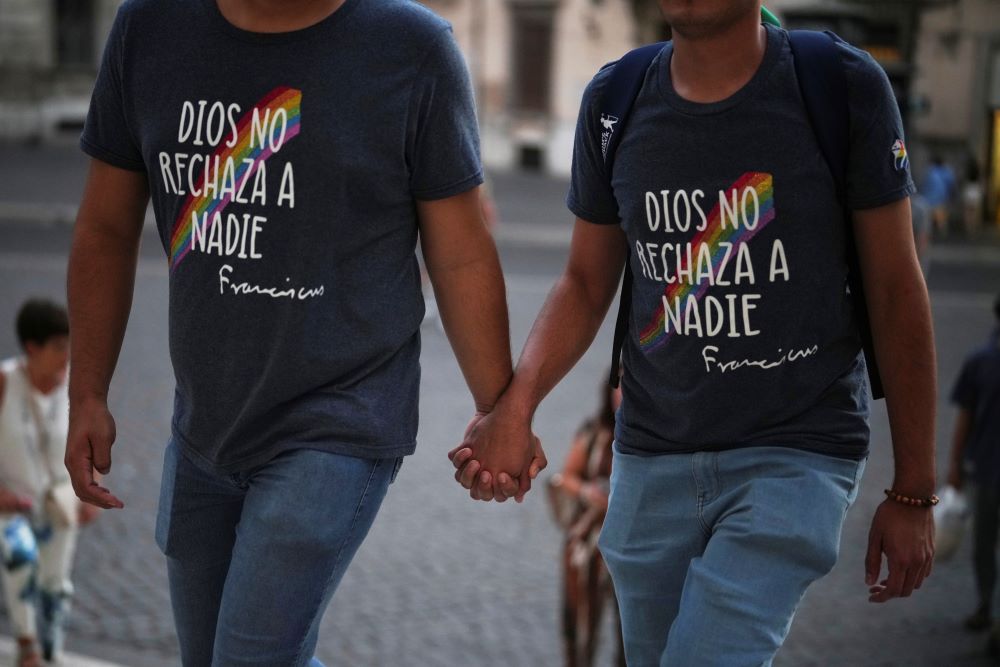
Members of the LGBTQ+ community, wearing T-shirts reading "God does not reject anyone" in Spanish, arrive to attend a vigil prayer in the Church of the Gesù in central Rome Sept. 5. (AP /Andrew Medichini)

by Ish Ruiz
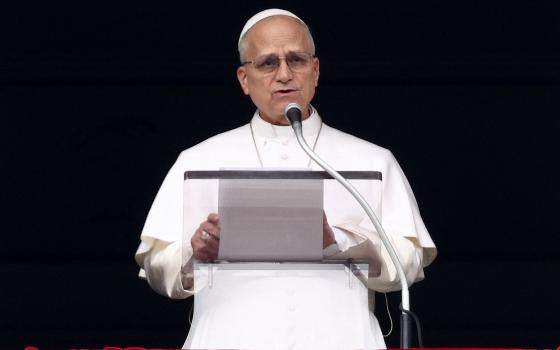
Like those of many LGBTQ+ Catholics, my spiritual life is an embattled one; the constant struggle to take up space in the church as my full and authentic self is exhausting. So when I read Jesuit Fr. James Martin's comments on his papal audience with Pope Leo XIV a few weeks ago, I felt encouraged. Leo said he planned to continue the pastoral approach of Pope Francis toward LGBTQ+ people.
Given Francis' welcoming approach, de-emphasis of doctrinal rigorism, support for Fiducia Supplicans and calls for a synodal church, this was good news. While not perfect, Francis' approach laid an important groundwork for LGBTQ+ inclusion.
Last week, in an interview with Elise Ann Allen, Leo expounded on his approach. While he said he wants the church to be open to everyone, fearing polarization, he also said that it would be "highly unlikely, certainly in the near future," that church doctrine on sexuality would change.
It was hurtful to hear.
No matter how loudly we proclaim "todos, todos, todos" to try to welcome LGBTQ+ people, postponing doctrinal reform perpetuates our rejection. It suggests that LGBTQ+ Catholics may be seen but not fully embraced, welcomed but never celebrated, included but always conditionally. It expects us to take comfort in crumbs while we hunger for the full bread of communion. We don't just want to be inside the church building; we want our love and our identities to be cherished as integral parts of the Catholic story.
If we are to take seriously the synodal call, we must commit to listening to the movement of the Spirit through the lives of LGBTQ+ Catholics. Synodality is not an endless holding pattern where marginalized communities are asked to wait until the hierarchy is ready. It is not a polite listening session followed by inaction. True synodality listens with the intent to act — to be transformed by the voices of those at the margins. Anything less is a parody of the Spirit's work.
Telling LGBTQ+ Catholics that they are "welcome," but that doctrine will not change is like inviting someone into your home and then telling them, "Please don’t move the furniture." It keeps us as guests, never as family. We may be tolerated as people in need but not trusted as people who possess wisdom.
Most importantly, this partial welcome is not neutral; it is harmful. Studies show that LGBTQ+ people, especially youth, face higher rates of depression, suicide, homelessness and family rejection — and that religion often provides the operating principles for this rejection. The church's stance, no matter how kindly spoken, contributes to this suffering. When church leaders hesitate, equivocate or delay, LGBTQ+ Catholics pay the price with our lives and well-being.
For now, some of us continue to wait. We wait for the church to recognize what we already know: that our loves are holy, our lives bear fruit and our dignity is God-given.
No matter how loudly we proclaim 'todos, todos, todos' to try to welcome LGBTQ+ people, postponing doctrinal reform perpetuates our rejection.
And while we wait, LGBTQ+ Catholics continue to show extraordinary grace. We keep showing up, praying, serving and building community even as we grieve our losses and carry wounds from exclusion. Our perseverance is itself a witness that the Spirit is alive in us, even when the institution hesitates to recognize it.
Our hope does not rest on a pope's timeline but on God's promise. We trust that the God who created us in love will not abandon us. While this hope is real, it does not excuse the church from its responsibility. The onus is on church leaders to meet our faith with courage, to open its doors fully and to embrace the doctrinal reform the Gospel demands. And it should start with Pope Leo XIV.
Jesus never told the leper, "I will heal you, but not anytime soon." He never told the bleeding woman, "Your suffering matters, but I must first consult the Pharisees." He never told Bartimaeus, "Your blindness is a threat to people with sight." He never told the Samaritan woman, "You may drink, but only if you stay quiet so as not to scandalize the children or threaten the fabric of society." Jesus moved with urgency toward those on the margins.
The church must do the same. To say that we are welcome, but our embodied identity and our love are sinful is to shortchange human dignity for institutional comfort. It is to choose fear over courage.
Advertisement
LGBTQ+ Catholics long for recognition, justice and joy. We are not asking to be tolerated in the corner; we are asking the church to respect our dignity and allow us to take our rightful place as a part of God's people.
Synodality calls us to move the furniture, rearranging the household of God so that no one is left on the periphery. And the Gospel calls us to act without delay.
"Certainly not in the near future" cannot be the church's answer. The Gospel's timeline is always now.