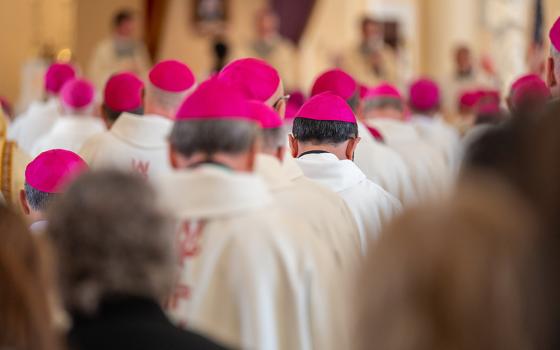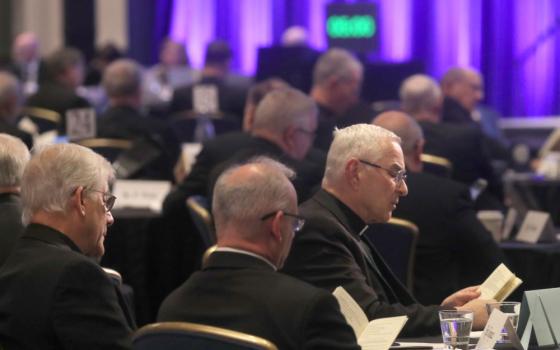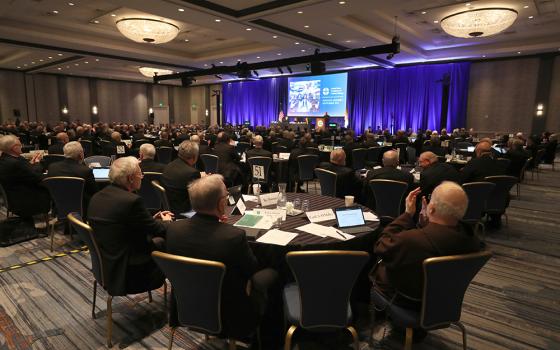
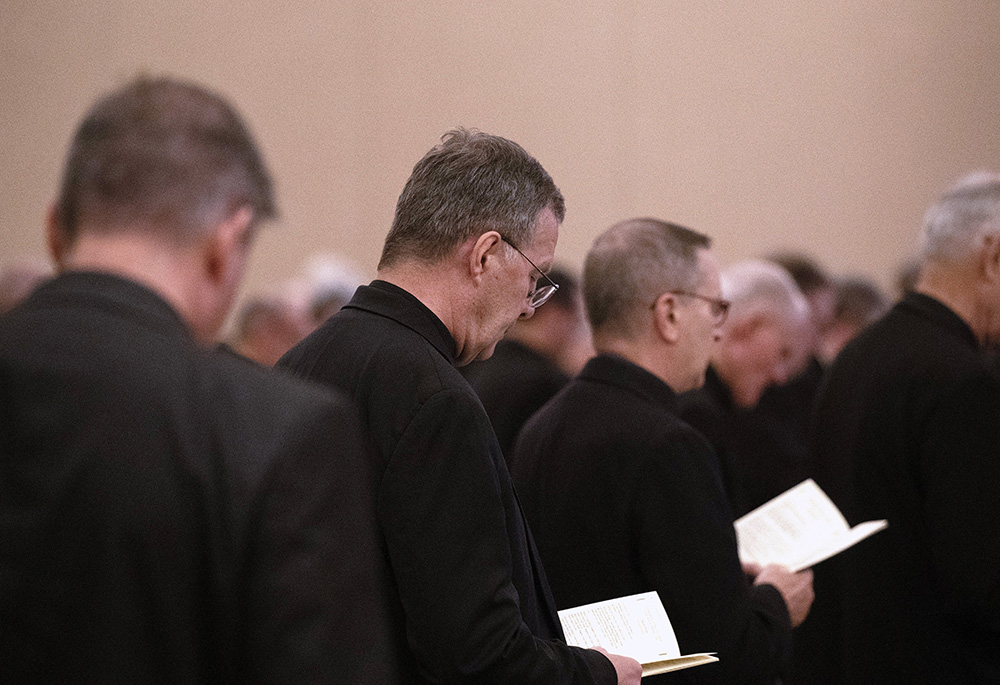
Bishops pray June 13, 2024, at the U.S. Conference of Catholic Bishops' spring plenary assembly in Louisville, Kentucky. The U.S. bishops' 2025 fall plenary takes place Nov. 10-13 in Baltimore. (OSV News/Bob Roller)

Good morning from Baltimore where the U.S. bishops begin their plenary meeting today. Most bishops started arriving over the weekend, when the various committees of the conference have their preparatory meetings, with some stragglers coming in late last night.
In case you missed them, here is my column about the need for new leadership at the bishops' conference, and another column handicapping the contest for conference president.
As they have done the past few years, the bishops will begin today in executive session closed to the press. My colleague Jesuit Fr. Tom Reese thinks it is "a scandal" that fully half of the annual gathering is being held behind closed doors. "The bishops are admitting they cannot in public 'freely and candidly discuss' topics central to the papacy of Pope Francis: synodality, 'Laudato si'' and the apostolate of the laity." It is frustrating to us in the press corps, to be sure, but synods were closed to the press by Francis too. Indeed, few things defeat effective synodality faster than speakers playing for the cameras. And, I have noted before that efforts by special interest groups to influence the bishops' discussions are the antithesis of synodality.
This year, a large cloud hangs over the meeting. The draconian immigration enforcement actions perpetrated by the Trump administration have brought fear to the immigrant community, so many of whom are fellow Catholics. Bishop Kevin Rhoades, of Fort Wayne-South Bend, chair of the bishops' conference's Committee on Religious Liberty and a consultant on President Donald Trump's Religious Liberty Commission, delivered a rare criticism of the Trump administration for their failure to allow ministers to bring holy Communion to detained immigrants in Chicago.
The bishops must decide how they will address the enormous, pernicious problem that is afflicting so many immigrants. Immigration and abortion have long been the two issues that mostly unite the conference and we can expect a forceful statement from Archbishop Timothy Broglio in his presidential address and perhaps a statement from the entire body of bishops. More important, however, will be the degree to which the bishops commit to actions to protect migrants, such as accompanying migrants to court for their legally mandated check-ins, a form of witness and protection begun by Bishop Michael Pham of San Diego.
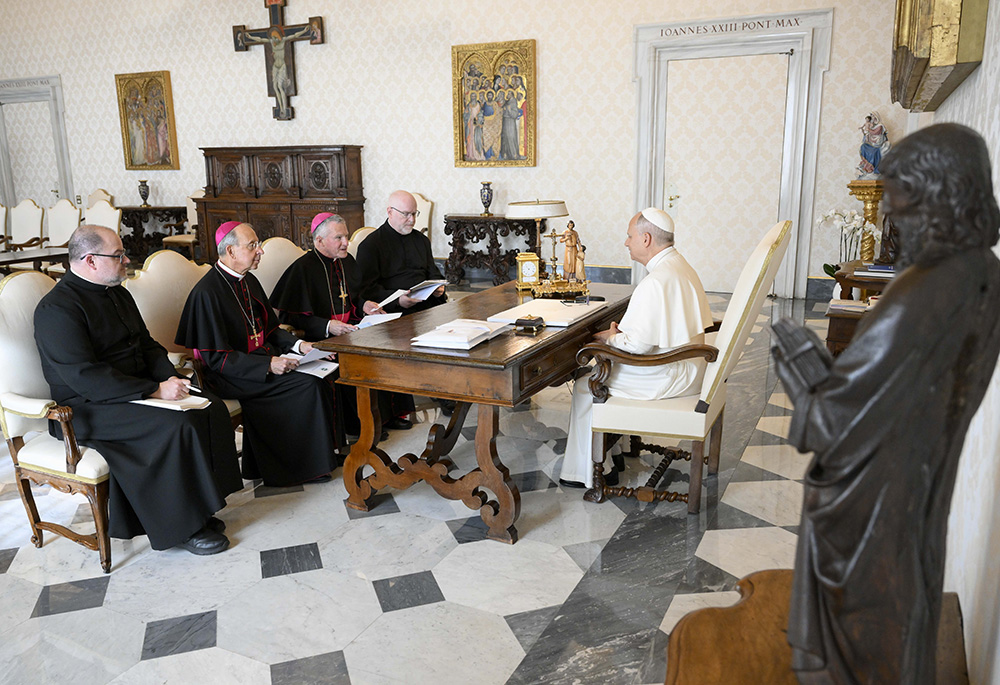
Pope Leo XIV meets with officials of the U.S. Conference of Catholic Bishops, in the library of the Apostolic Palace at the Vatican Oct. 10, 2025. From the left are: Fr. Michael Fuller, general secretary; Baltimore Archbishop William E. Lori, vice president; Archbishop Timothy P. Broglio, president; and Fr. Paul Hartmann, associate general secretary. (CNS/Vatican Media)
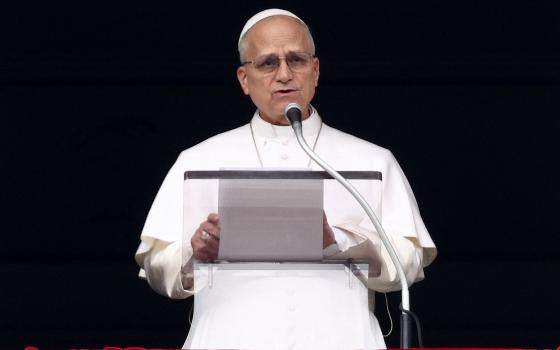
If there is a cloud over the meeting this year, there is also a rainbow. Every year, the meeting begins with the bishops sending a message of solidarity to the pope. This year, for the first time, they will send that message to a pope who also carries a U.S. passport.
Americans are accustomed to hearing a pope's words through the voice of an interpreter. Now, they can hear his words from his own mouth. This is a huge opportunity for the church's efforts to evangelize. This came up during a panel at Boston College's Boisi Center, celebrating that center's 25th anniversary, at which I mentioned the Holy Father's response to a question about the controversy surrounding Cardinal Blase Cupich's decision to award a prize to Sen. Richard Durbin. What Pope Leo said was no different from what Francis would have said, but we heard it from his own lips, in American English. It landed differently, more comprehensively and more directly, and its reach extended beyond the Catholic press.
Advertisement
Leo has indicated the direction in which he will lead the Catholic Church is largely along the lines charted by Francis, including efforts to make ours a more synodal church. Heading into the 2024 synod, Bishop Robert Barron suggested that the church in the U.S. was already very synodal. He wrote: "For instance, [the working document] calls for the development, across the international Church, of lay pastoral councils, finance councils, various organs of accountability, etc. A point that I made often in the first round of the synod is that, in our country, most of these 'synodal' institutions are already in place." Nothing much left to do.
The Holy Father recently took questions at the Jubilee of Synodal Teams and Participating Organizations. At one point he spoke specifically about the situation of the church in the U.S. and he clearly sees the need for further work. "So with that, I think that the concrete reality — understanding within the American, United States culture — is that many structures which already exist have great potential for being synodal," the pope said. "We must find ways of continuing to transform them into more inclusive kinds of experiences. Whether on pastoral councils, or in other diocesan structures or gatherings, the inclusion of people — men and women, laity and clergy, women and men religious, et cetera — can help all to take part and feel a deep co-responsible sense of belonging, leadership and accountability in the life of the church." "Potential." "Continuing to transform." There is a lot more to do.
Leo is a young, even vigorous, 70 years old. Those prelates who thought they could outlast Francis and resisted his reforms must recognize they will not outlast Leo. The bishops this week will need to decide whether they will follow the Holy Father's lead, or not?
By week's end, we will have some answers to that question.