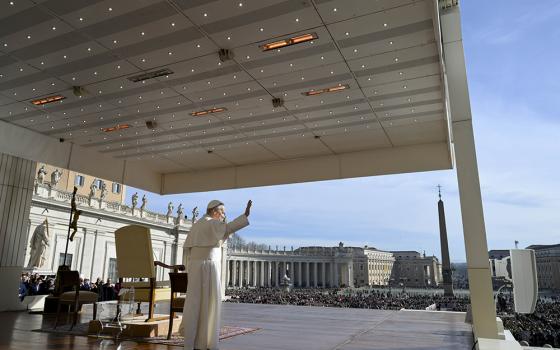
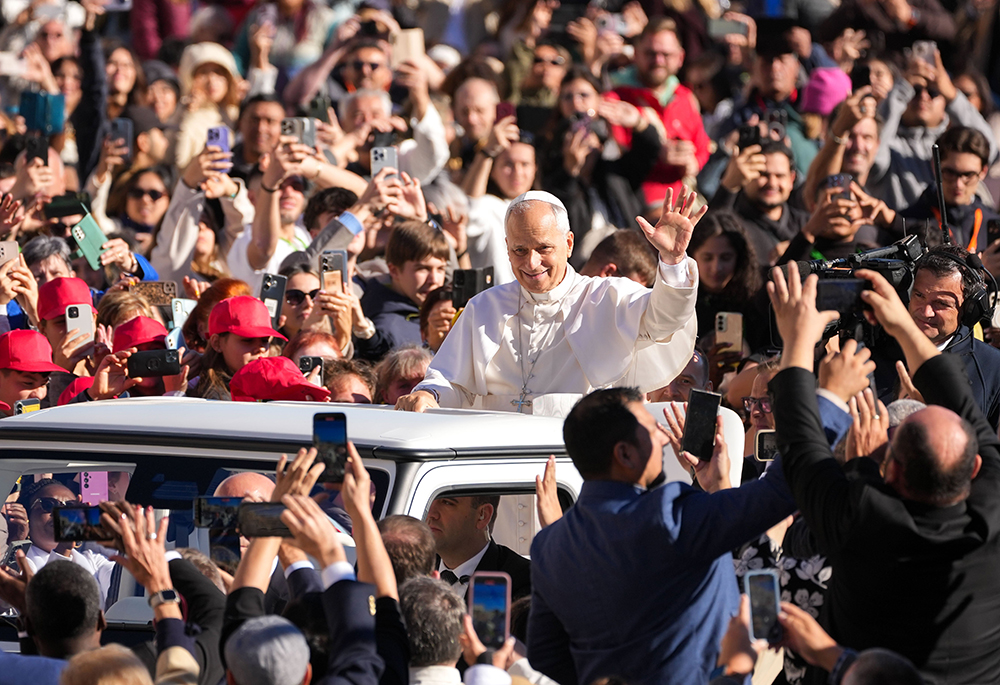
Pope Leo XIV greets visitors and pilgrims from the popemobile as he rides around St. Peter's Square at the Vatican before his weekly general audience Nov. 5, 2025. (CNS/Lola Gomez)

For an institution that measures epochs in centuries rather than electoral cycles, six months may seem a modest window to assess a pontificate. Yet as Pope Leo XIV marks that milestone Nov. 8, a gradual sketch of his style and vision of church is beginning to emerge.
Leo has not sought to redefine the papacy with impromptu remarks or sweeping gestures in his first half year as pope. Instead, his quiet and steady leadership has prodded the church along a path charted largely by his predecessor while balancing prophecy with prudence.
Here are six areas that trace the outlines of Leo's first six months as pope:
Church unity
Following a conclave where "unity" became what the New York Times called a code word for peeling back the pastoral-first, listening model of church championed by Pope Francis, Leo inherited the challenge of holding together a polarized church even as he signals continuity with his predecessor's course.
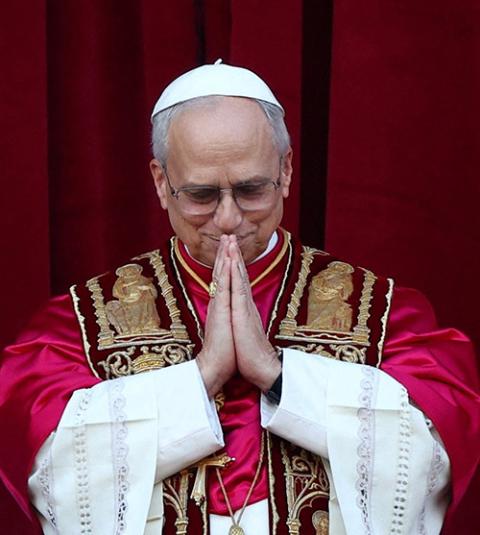
Pope Leo XIV pauses on the central balcony of St. Peter's Basilica at the Vatican May 8, 2025, following his election during the conclave. (OSV News/Reuters/Guglielmo Mangiapane)
He pleased those hoping for a return to the traditional trappings of the papacy with his first public gesture: appearing May 8 on the balcony of St. Peter's Basilica with the red papal mozzetta — a cape-like symbol of the papacy eschewed by Francis. That image, along with other measures like using the papal summer residence and an expected move back to the papal apartments in the Apostolic Palace, encouraged some traditionalist Catholics who hoped for a return to a pre-Francis pontificate.
And Leo gave them cause to be curious. He met individually with conservative Cardinals Robert Sarah, and Raymond Burke, both vocal advocates of the expanding access to the pre-Vatican II Mass restricted by Francis. Leo then allowed Burke to celebrate a Tridentine Mass Oct. 25 in St. Peter's Basilica during a traditionalist Catholic pilgrimage, spurring hope that he would soften restrictions on celebrating Mass in the pre-Vatican II rite.
But Leo's speech has remained tightly within Francis' line. In his first address following his election he called for a "synodal church" — a reference to his predecessor's efforts to make a more listening and participatory church. Synodality, which Sarah and Burke have publicly opposed, "is not a campaign, it is a way of being and a way of being for the church," Leo recently told pilgrims involved in organizing synod projects.
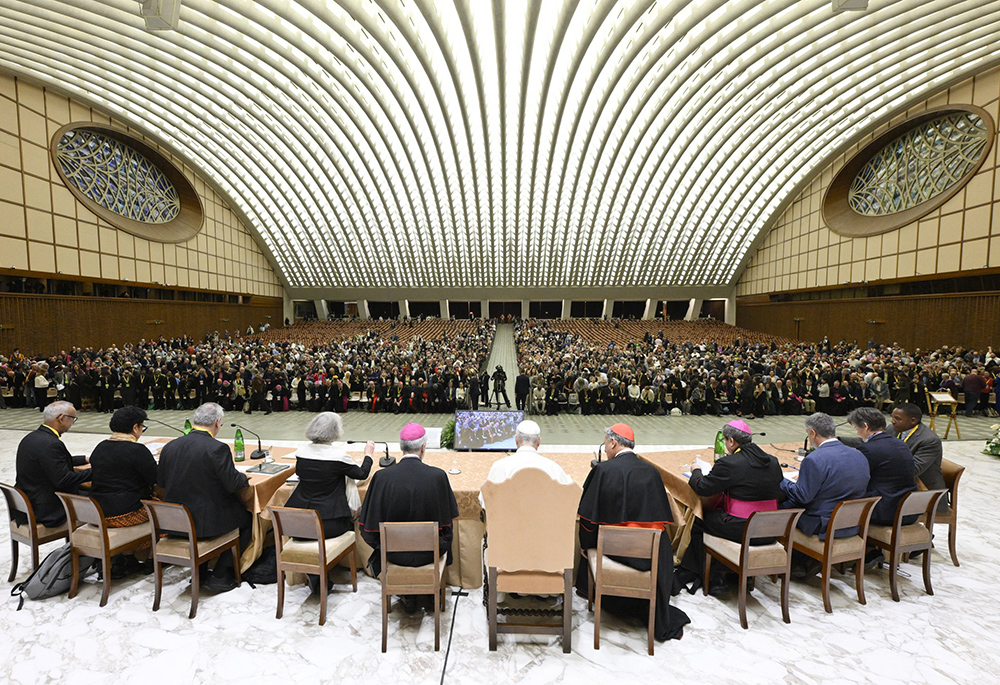
Pope Leo XIV, with regional representatives of synod teams, listens to and answers questions from participants in the Jubilee of Synodal Teams and Participatory Bodies in the Vatican audience hall Oct. 24, 2025. (CNS/Vatican Media)
On ecology, immigration and inclusivity in the church, Leo has largely echoed Francis. He inaugurated a Vatican school for integral ecology studies, criticized the Trump administration's treatment of migrants and met with Jesuit Fr. James Martin, a prominent advocate for LGBTQ+ Catholics, indicating a desire to continue Francis' engagement with that community.
That balance was captured in a refrain heard among Vatican watchers in the early days of the pontificate: "Leo looks like Benedict but speaks like Francis."
For the moment, it appears Leo has given Catholics across the ideological spectrum reasons to rejoice.
Championing migrants and the marginalized
Perhaps more than any other hot-button issue, Leo has been particularly poignant in discussing migration.
In direct comments and conversation, more than in speeches or homilies, the pope has repeatedly underscored the need to uphold the human dignity of migrants and he has not shied away from doing so in a U.S. context.
"I think it's so important that we as church give a message of hope in the midst of these horrible struggles of what's going on in so many cities in the United States right now," Leo told Bishop Mark Seitz of El Paso during an Oct. 8 meeting at the Vatican. "The church cannot be silent."
"I wish there were a stronger, more united voice" on immigration issues from the U.S. bishops' conference, he went on to say in a video of their meeting.
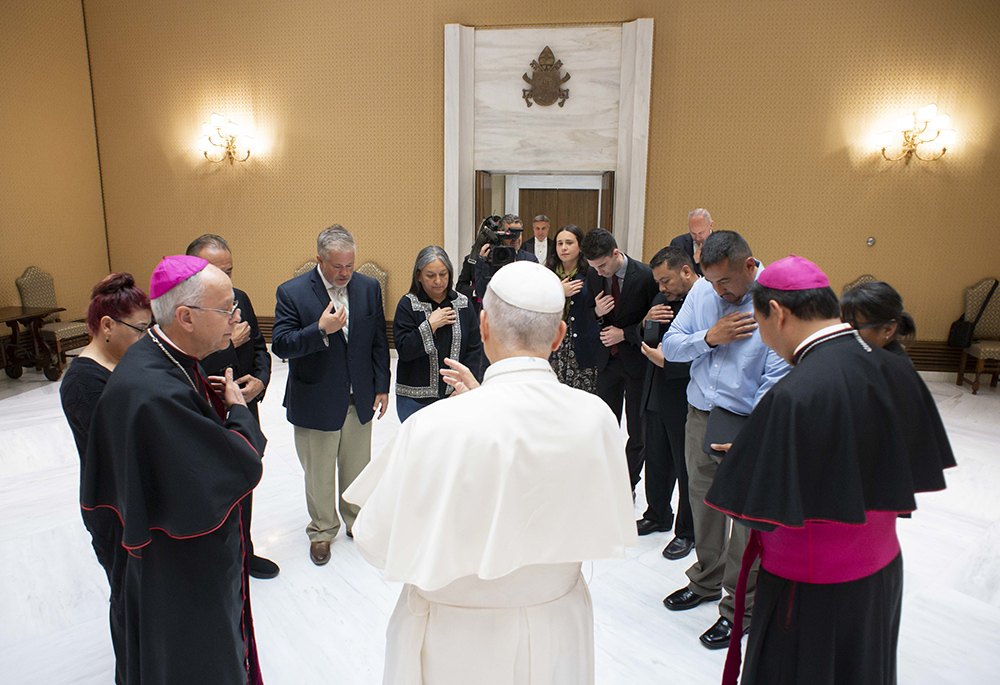
Pope Leo XIV blesses Bishop Mark J. Seitz, left, and Auxiliary Bishop Anthony C. Celino of El Paso, right, along with representatives of the Hope Border Institute and others who assist migrants in the United States during a private meeting at the Vatican Oct. 8, 2025. (CNS/Vatican Media)
And responding to questions from reporters, Leo questioned whether someone who is against abortion but "in agreement with the inhuman treatment of immigrants who are in the United States" can be considered "pro-life."
The pope's comment prompted a response from White House Press Secretary Karoline Leavitt, a Catholic, who rejected the pope's characterization of the Trump administration's treatment of migrants.
Beyond the question of migration, Leo's first major text, the apostolic exhortation Dilexi Te ("I Have Loved You"), set a clear moral tone for his pontificate in siding with the world's poor. Building on a draft of the document started by Francis, Leo issued a forceful critique of growing inequality, lamenting "a wealthy elite, living in a bubble of comfort and luxury" while the number of poor continues to climb.
"I am convinced that the preferential choice for the poor is a source of extraordinary renewal both for the Church and for society," he wrote.
Advertisement
Personnel as pastors
Leo's first major curial appointment made a statement. He named Sr. Tiziana Merletti, a member of the Franciscan Sisters of the Poor, as secretary of the Dicastery for Consecrated Life, showing in his first days as pope that he will not stop the momentum on elevating women through the highest echelons of the church promoted by Francis.
The late pope appointed Consolata Missionary Sr. Simona Brambilla prefect of that dicastery in January, making her the first woman to lead a Vatican prefect.
For other positions, Leo has shown he is not afraid to take his time in discerning who the right person is for the job.
Leo left vacant for more than four months his former post as head of the Vatican office responsible for identifying bishops around the world before naming Archbishop Filippo Iannone, prefect of the Dicastery for Legislative Texts, to fill the role. The appointment of a relative unknown surprised some, but Iannone boasts a long track record as a bishop and the nature of his work in the Curia suggests he often worked closely with other Vatican departments.
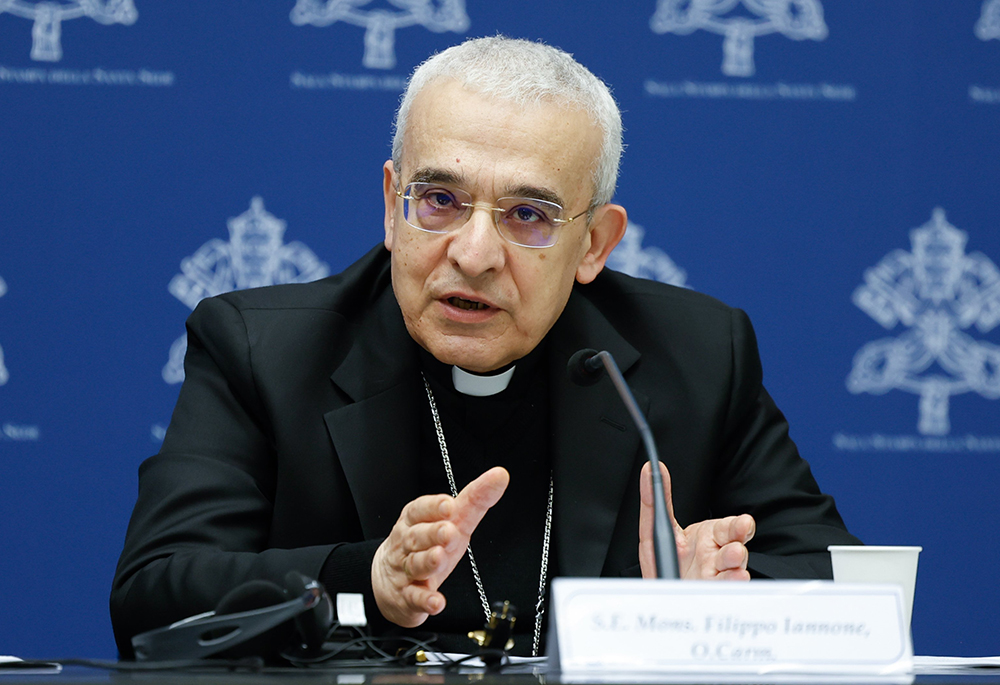
Archbishop Filippo Iannone, named prefect of the Dicastery for Bishops by Pope Leo XIV Sept. 26, 2025, is seen at the Vatican in this file photo from March 14, 2024. (CNS/Lola Gomez)
Leo has been critical of the siloed nature of working within the Roman Curia and said in his first interview as pope that he is preparing new legislation aimed at improving cooperation among the Vatican's dicasteries.
Other noteworthy appointments included placing Cardinals Blase Cupich of Chicago and Baldassare Reina, papal vicar for Rome, on the commission which governs Vatican City State.
Those nominations, as well as Iannone's, show Leo's penchant for elevating longtime pastors with proven track records as administrators. That profile falls in line with the pope's own background, which balanced pastoral care and practical consideration.
Before becoming pope, Leo was a canon lawyer, a missionary, head of the global Augustinian religious order, a bishop and ultimately prefect of one of the Vatican's most consequential bodies, the Dicastery for Bishops.
Building bridges
Diplomatically, Pope Leo has shown a preference for quiet engagement over public spectacle. He has used the Vatican's behind-the-scenes influence rather than the high-visibility appeals that characterized some of Francis' interventions.
Whereas Francis consistently called for prayers for "martyred Ukraine" at the end of his weekly general audiences, Leo opted not to continue that pattern. Instead, Leo has opted for direct dialogue, meeting in July with Ukrainian President Volodymyr Zelenskyy at the papal summer residence outside Rome.
Francis spoke frequently and forcefully to condemn Israel's military action in Gaza, calling for investigation into whether the attacks amount to genocide.
Nearly two years after the war in Gaza began, Leo met with Israeli President Isaac Herzog at the Vatican, becoming the first pope to meet with an Israeli leader in seven years.
On Nov. 6, he also met with Palestinian President Mahmoud Abbas for the first time at the Vatican. The two discussed the "urgent need to provide assistance to the civilian population in Gaza and to end the conflict by pursuing a two-state solution," the Vatican said.
Leo has also become a unifying force among Christians.
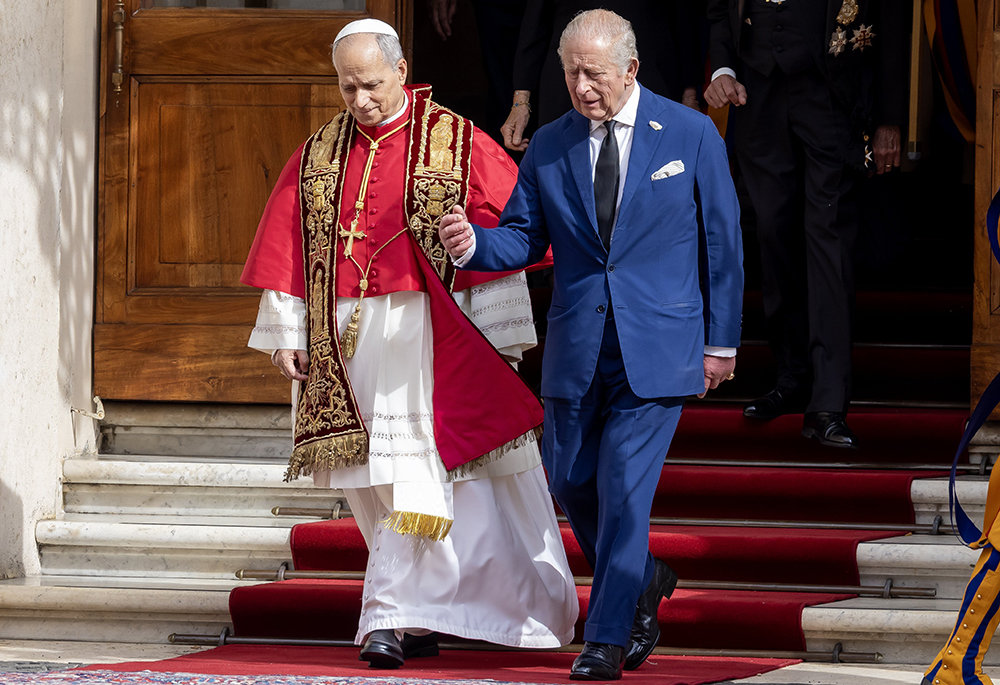
Pope Leo XIV accompanies Britain's King Charles III to the San Damaso Courtyard of the Apostolic Palace at the Vatican at the end of their visit, Oct. 23, 2025. (CNS/Pablo Esparza)
In an historic ecumenical prayer service Oct. 23 in the Sistine Chapel, Leo prayed side by side with Britain's King Charles III, the titular head of the Church of England, and Queen Camilla; it was the first time a pope has prayed with a British monarch since the Church of England split from Rome in the 16th century.
The monarchs' visit to Rome was originally scheduled for April — they stopped by the Vatican to greet Pope Francis during a state visit to Italy — but Leo moved ahead with the meeting and, in a gesture that broke from custom and did not go unnoticed, he personally accompanied the royal couple back to the courtyard of the Vatican's Apostolic Palace to their limousine.
Leo has also met twice with Ecumenical Patriarch Bartholomew of Constantinople, the spiritual leader of the world's 300 million Orthodox Christians, in his half year as pope. The two religious leaders are expected to meet again during the first international trip of Leo's pontificate Nov. 27-Dec. 2, when he visits Turkey to mark the 1,700th anniversary of the Council of Nicaea before traveling to Lebanon.
In a meeting with a delegation of the Ecumenical Patriarchate in June, Leo affirmed his commitment to "restore full visible communion between our churches."
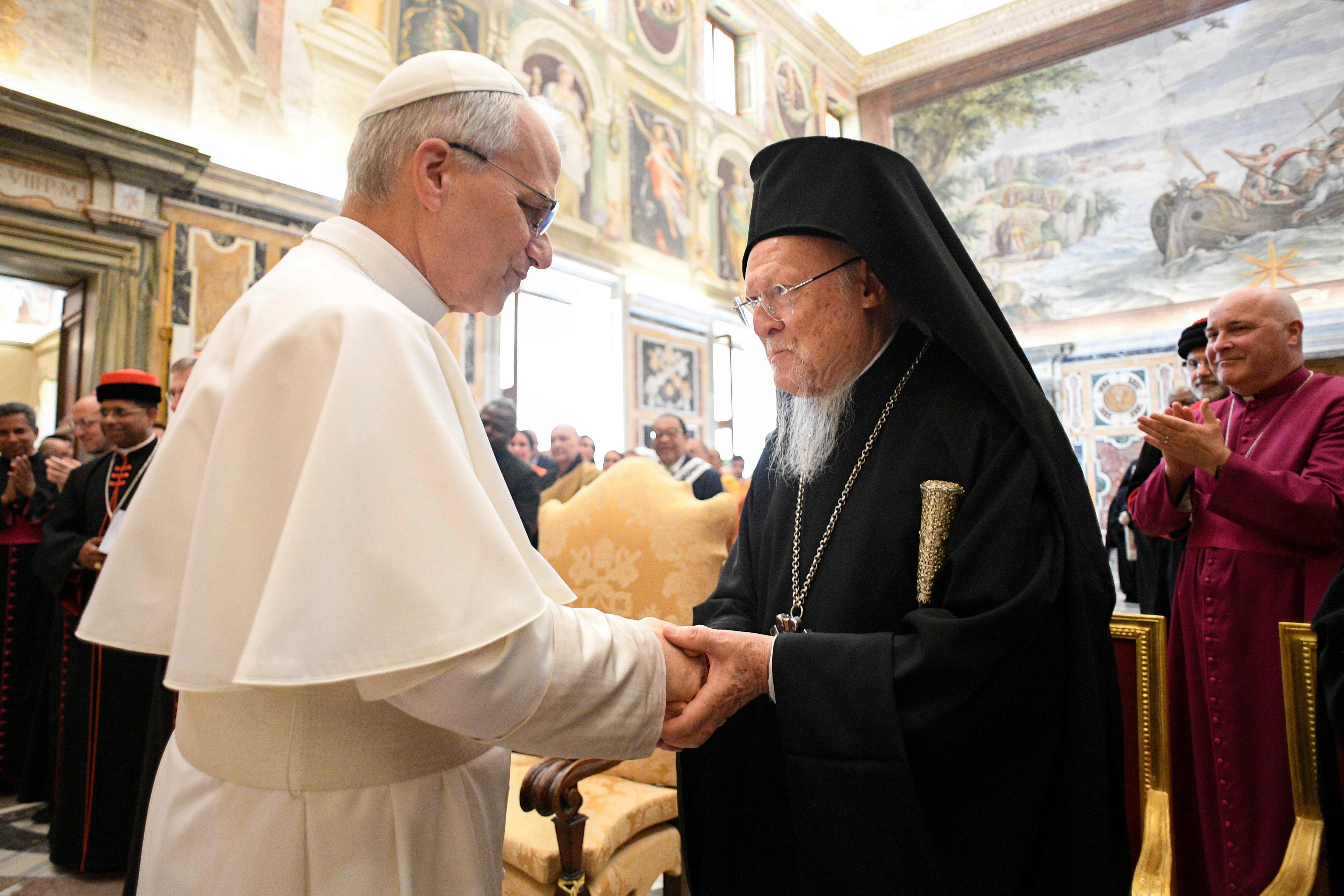
Pope Leo XIV greets Orthodox Ecumenical Patriarch Bartholomew of Constantinople during a meeting with religious leaders at the Vatican, May 19, 2025. The leaders had come to Rome for the pope's inauguration Mass. (CNS photo/Vatican Media)
Artificial intelligence
Few issues have drawn more anticipation for papal engagement than the development of artificial intelligence.
Leo has framed this as a defining challenge of the age, likening today's technological upheaval to the industrial revolution that Pope Leo XIII addressed in his 1891 encyclical Rerum Novarum. His choice of papal name paid homage to that predecessor.
Although speculation persists that Leo's first encyclical will address AI and social ethics, no official document has been announced. The pope's public comments on AI have been relatively scant, but they have mixed promise with preoccupation.
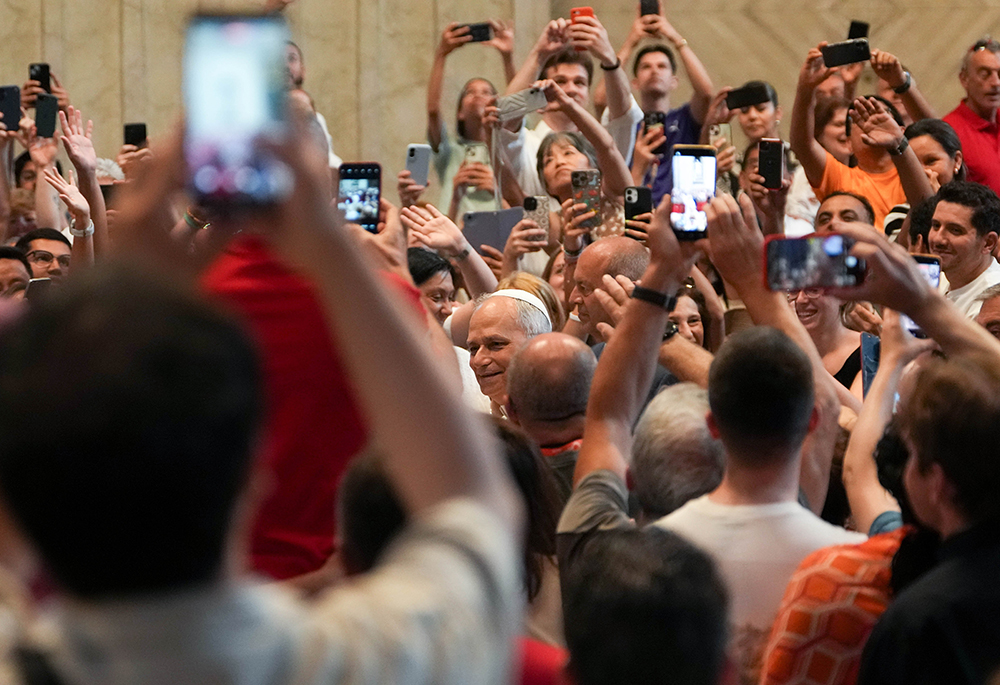
In this file photo from June 14, 2025, Pope Leo XIV greets people as they hold up cellphones to take photos and videos as he enters St. Peter’s Basilica for an audience with pilgrims in Rome for the Holy Year 2025. (CNS/Lola Gomez)
In a June message on AI ethics, Leo expressed hope that artificial intelligence could serve humanity, while warning that it can also stunt the growth of young people who are coming of age in a technology-saturated world.
"Authentic wisdom has more to do with recognizing the true meaning of life, than with the availability of data," he said.
The pope did select "Preserving human voices and faces" as the theme for next year's World Communications Day, a warning against the fake AI content that he himself has repeatedly fallen victim to.
Leo's first six months may leave some observers wishing for more direct engagement on his part, but his choice of name, and the meaning he has attached to it, suggests he understands the high stakes of artificial intelligence in shaping human society. What remains to be seen is how he will choose to act.
Finances
Any new pope would have begun their pontificate with the cloud of the Vatican's financial situation looming over their zucchetto. The latest reporting places the Vatican budget shortfall of 83 million euro ($95 million) and the pension fund is speculated to have far surpassed the 631 million euro ($728 million) deficit last officially reported in 2022.
Chicago Cardinal Blase Cupich told America magazine that the ongoing reform of the Curia, including getting the Vatican's finances in order and long-term management of its pension fund, was the issue of greatest concern at the beginning of the papacy.
In October, Leo issued a decree — his first — revising one of Francis' 2022 reforms which had centralized all Vatican investments under the Institute for the Works of Religion, commonly known as the Vatican bank. The new law allows Vatican departments to manage funds through other financial institutions if the competent bodies "deem it more efficient or convenient" while still adhering to the Vatican's ethical investment guidelines.
Though modest in scope, the change signaled Leo's willingness to recalibrate structures rather than dismantle reforms. Some Vatican officials had complained that the earlier policy gave the bank too much power and created bureaucratic delays.
Just over a week earlier, Leo reassigned a close Francis ally, Msgr. Roberto Campisi, who headed the Vatican's fundraising commission, to serve as ambassador to UNESCO in Paris. The move was widely read as the pope's effort to refresh a commission that had faced credibility concerns for its lack of experience and international representation.
The pope has downplayed financial concerns in the Vatican while acknowledging that problems do exist. As a cardinal, he served on several Vatican finance committees.
Yet the church must also work to rebuild its credibility after financial scandals, he said in an interview with the Catholic news outlet Crux.
He referred to remarks made at a meeting with the Council of the Economy, about communications being part of the Vatican's problem. "The Vatican has oftentimes given the wrong message, which certainly doesn't inspire people to say, 'Oh, I'd like to help you,' [but rather,] 'I'll keep my money, because if you're not going to administer properly, why should I give you more?' " he said.
Whether Leo can succeed in stabilizing the Vatican's finances or simply restoring credibility to its management, his early actions suggest his approach to reform will come not through rupture, but by steady revision.
The National Catholic Reporter's Rome Bureau is made possible in part by the generosity of Joan and Bob McGrath.