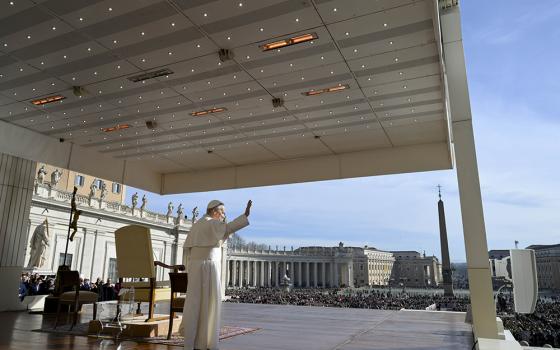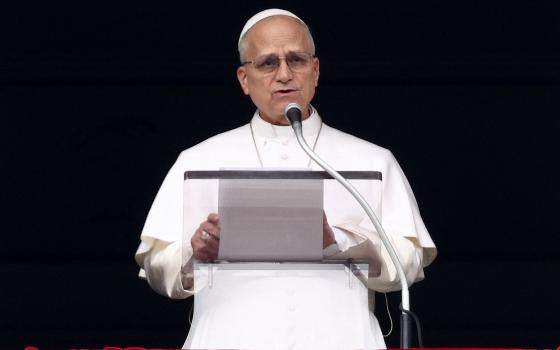
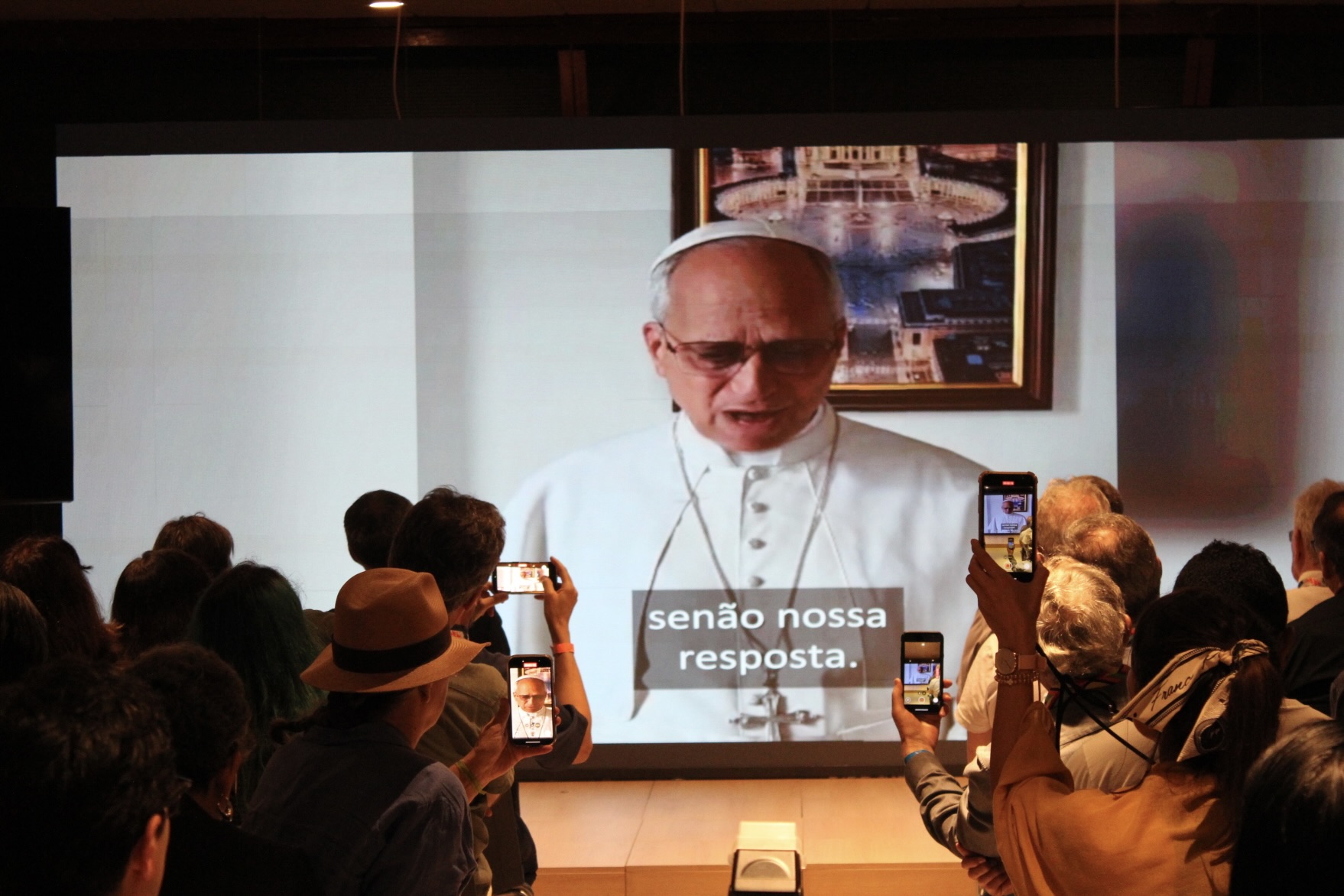
Pope Leo XIV delivers a video message to a gathering at the Amazonian Museum of Belem on Nov. 17 during the COP30 United Nations climate change conference. (Paulo Augusto)
Pope Leo XIV urged countries at United Nations climate talks to take "concrete actions" to stop climate change that is threatening the planet, telling them humans are failing in their response to global warming and that God's creation "is crying out in floods, droughts, storms and relentless heat."
In a video message played for religious leaders Nov. 17 gathered in Belém, Leo said nations had made progress, "but not enough."
"One in three people live in great vulnerability because of these climate changes," Leo said. "To them, climate change is not a distant threat, and to ignore these people is to deny our shared humanity."
His message came as the talks, known as COP30, were moving into their second week, with high-level ministers from governments around the world arriving at the edge of the Brazilian Amazon to join negotiations. Monday was dominated by speeches, with several leaders from Global South nations giving emotional testimony on devastating costs of recent extreme weather and natural disasters.
Vulnerable nations have pressed for more ambition at these talks as world leaders have begun to acknowledge that Earth will almost surely go past a hoped-for limit — 1.5 degrees Celsius (2.7 degrees Fahrenheit) in Earth's warming since pre-industrial times. That was the target set at these talks in 2015 in the landmark Paris Agreement, under which nearly 200 nations for the first time each committed to reducing heat-trapping greenhouse gas emissions toward reaching net-zero emissions by 2050.
Scientists say in addition to deadly heat, a warming atmosphere leads to more frequent and deadly extreme weather such as flooding, droughts, violent downpours and more powerful hurricanes.
Leo said there's still time to stay within the Paris Agreement, but not much.
"As stewards of God's creation, we are called to act swiftly, with faith and prophecy, to protect the gift He entrusted to us," he said. And he added: "But we must be honest: it is not the Agreement that is failing, we are failing in our response. What is failing is the political will of some."
"True leadership means service, and support at a scale that will truly make a difference," the pope said.
Leo made history this year by becoming the first U.S.-born pope, and has embraced Pope Francis’ environmental legacy, including dismissing climate skeptics.
The U.S., the world's second-largest polluter and largest historical source of emissions, is skipping the conference. U.S. President Donald Trump has moved to withdraw from the Paris accord for a second time, and called climate change “the greatest con job ever perpetrated on the world” during a speech to the U.N. General Assembly in September.
U.N. climate chief Simon Stiell said Leo's words "challenge us to keep choosing hope and action."
Leo "reminds us that the Paris Agreement is delivering progress and remains our strongest tool — but we must work together for more, and that bolder climate action is an investment in stronger and fairer economies, and more stable world," Stiell said.
The message marked the second the pope delivered to delegates and diplomats at COP30, following a statement that was read by Cardinal Pietro Parolin during the world leaders summit. His remarks Monday came at an event at the Amazonian Museum of Belém, where a group of cardinals from the Global South presented as a gift a replica fishing net of one that Indigenous leaders gave Pope Francis during the 2019 Synod on the Amazon.
Throughout COP30, cardinals, alongside other bishops and lay Catholics, have touted an unprecedented joint appeal from the Catholic Church in the Global South calling for the international summit to deliver climate justice and avoid "false solutions." In the appeal, the heads of the continental episcopal conferences for Latin America, Africa and Asia called for an immediate end to fossil fuel exploration and for Global North countries to compensate those in Global South for the effects of climate change and finance the necessary measures of energy transition and adaptation to the new climate reality.
In his message, Leo said he joined with "the prophetic voice" of cardinals at COP30 in "telling the world with words and gestures that the Amazon region remains a living symbol of creation with an urgent need for care."
"We are guardians of creation, not rivals for its spoils. Let us send a clear global signal together: nations standing in unwavering solidarity behind the Paris Agreement and behind climate cooperation," he said.
Fr. Dario Bossi, a member of the Integral Ecology and Mining Commission for the Brazilian bishops' conference, viewed the pope's message as a response to the joint letter from Global South bishops and "a demonstration that the Vatican has listened to our concerns."
"It was a daring and demanding message, out of the usual [grammar] of diplomacy, with strong and urgent words in line with the seriousness of the situation," he said.
David Gibson, director of the Center on Religion and Culture at Fordham University in New York, said Leo is becoming the world's most prominent moral leader against climate change.
"This message does stake Leo out as a voice for the rest of the world, especially the Southern Hemisphere where climate change is wreaking havoc with the vulnerable in Asia, Africa and Latin America," said Gibson.
And he said it shows that Leo, who spent decades working as a missionary in Peru and is a naturalized Peruvian citizen, "has a Latin American heart and voice."
The Laudato Si' Movement, a Catholic climate movement that takes its name from a 2015 encyclical in which Pope Francis called for climate action, called Leo's message "a profound moral intervention."
"He reminds the world that creation is crying out and that vulnerable communities cannot be pushed aside," the group's executive director, Lorna Gold, said. “His voice cuts through the noise of negotiations and calls leaders back to what truly matters: our shared humanity and the urgent duty to act with courage, compassion, and justice."
NCR staff contributed to this story.
Advertisement